What We Learned from Building Marketplaces for 3 Completely Different Industries in One Year

In the past year we built three marketplace platforms in three completely different industries.

A global charity processing $720M+ in donations. A car auction platform with full bidding and escrow flow. A B2B procurement marketplace for restaurants and professional kitchens.

Different users. Different transactions. Different trust thresholds. And yet the same patterns showed up every time.


The three builds

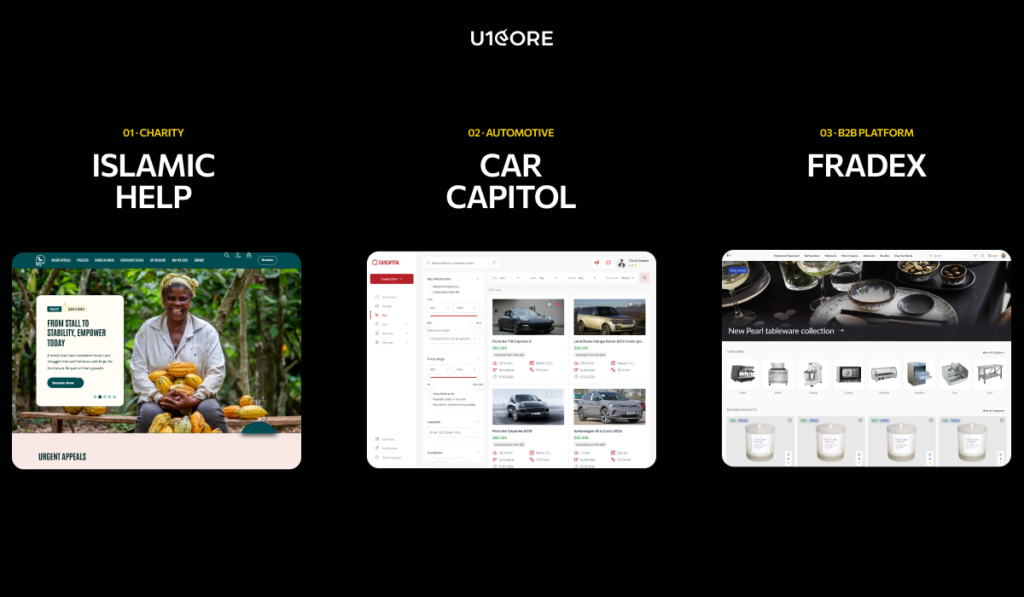
Islamic Help — a humanitarian fundraising platform across 40+ countries. Six ways to give, one engine underneath. Full product strategyUX architectureUI design system, donation flow logic, and brand identity.

CarCapitol — an automotive marketplace app with vehicle discovery, bidding, and buyer-seller communication. Full mobile design and custom software development — 100+ screens.

Frandex — a B2B e-commerce web platform for HoReCa. Catalog architecture, product cards, and search — built for professional buyers who know what they need.

What was the same every time

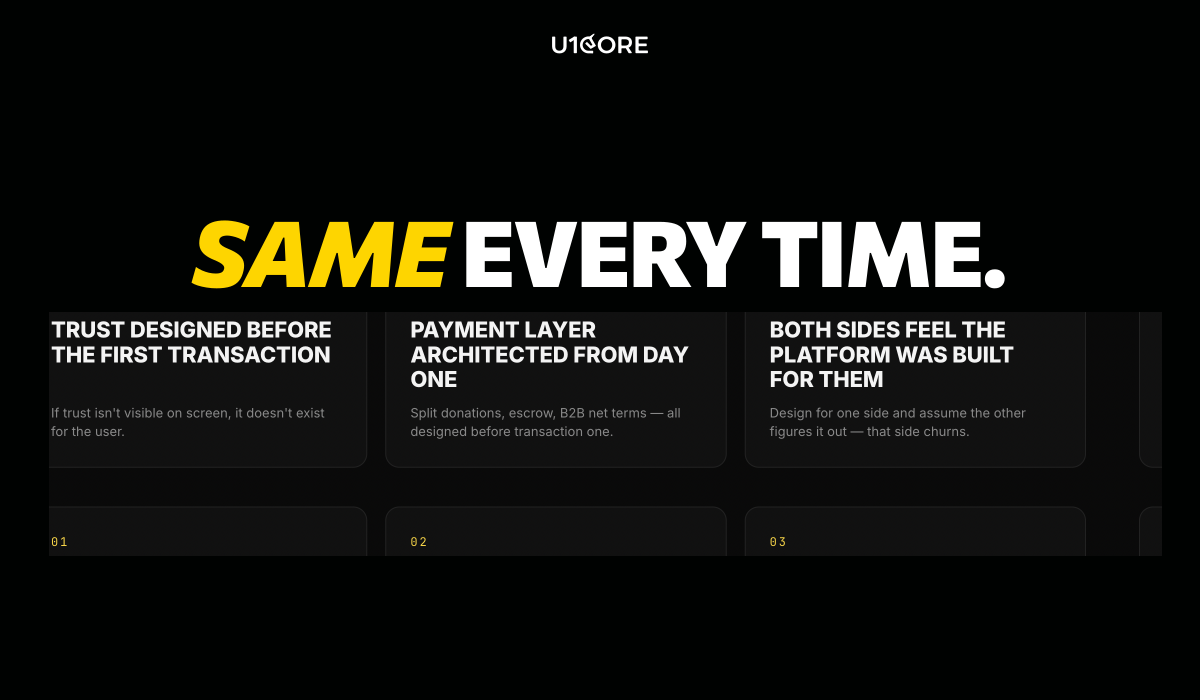
Trust had to be designed before the first transaction. Islamic Help donors needed to see where money goes. CarCapitol buyers needed verified identity and escrow before spending thousands. Frandex procurement managers needed supplier credentials and return policies. Three industries — same pattern. If trust isn’t visible on screen, it doesn’t exist for the user.

The payment layer needed architecture from day one. Islamic Help needed split donations across causes with automatic distribution at peak Ramadan load. CarCapitol needed escrow until vehicle delivery. Frandex needed B2B flows — purchase orders, invoicing, net terms. Three different custom software architectures. All designed before the first transaction.

Both sides needed to feel the platform was built for them. Donors and campaign managers. Buyers and sellers. Procurement teams and suppliers. The moment you design for one side and assume the other will figure it out — that side churns.

What was completely different

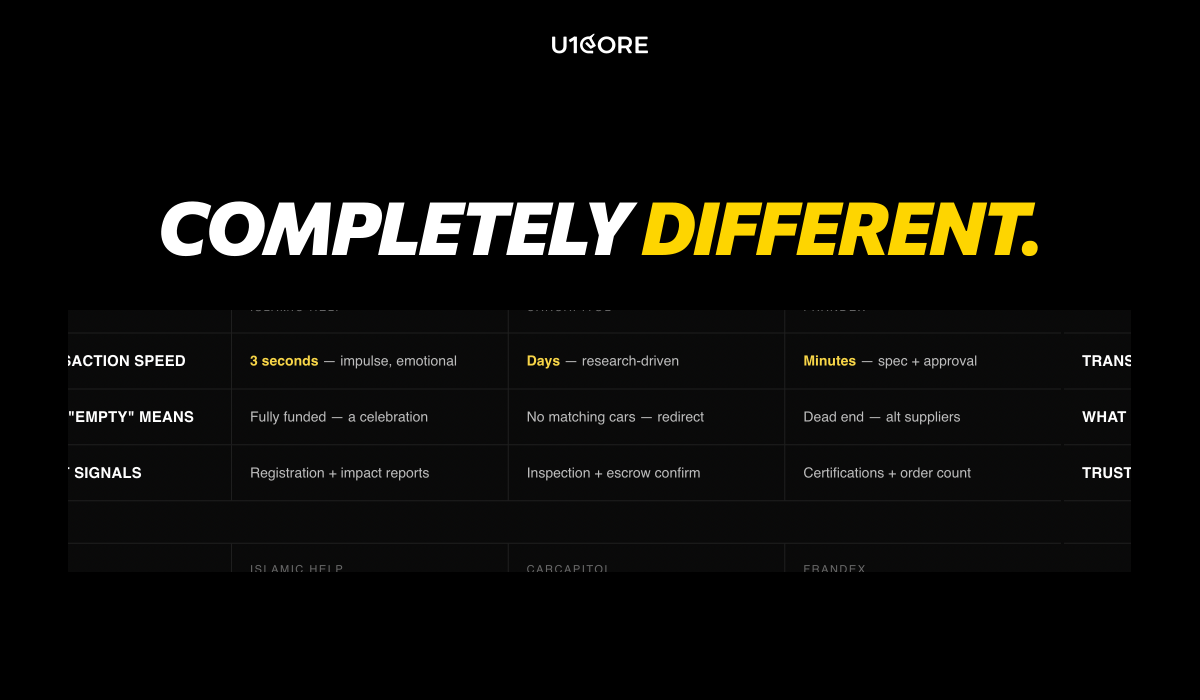
Transaction speed. A £5 Islamic Help donation happens in 3 seconds — emotional, impulse-driven. A $15,000 CarCapitol car purchase takes days — research-driven, rational. A Frandex B2B order takes minutes but involves spec comparison and approval chains. Same marketplace UX design principles. Completely different tempo.

What “empty” looks like. On Islamic Help an empty campaign means fully funded — a celebration. On CarCapitol it means no matching cars — needs a redirect. On Frandex it means a procurement dead end — needs alternative suppliers. Same problem. Three different web design solutions.

What trust signals look like. Islamic Help: charity registration and impact reports. CarCapitol: vehicle inspection and escrow confirmation. Frandex: supplier certifications and completed order count. Same concept. Three different expressions in the product design.

The one lesson that applies to every marketplace

The specific solution is always different. The underlying problems are always the same.

Trust before transaction. Payment architecture before launch. Both sides designed for equally. Empty states treated as a first impression, not a temporary bug.

Every marketplace design and development project we take on starts with these four foundations. The surface changes depending on your industry. The architecture underneath doesn’t.

Whether you’re processing donations, selling cars, or managing procurement — the decisions that determine success are made before anyone opens Figma.

Your vertical determines what the product looks like. But the product architecture underneath — trust, payments, dual-sided experience, empty states — is universal. Get those right and the web designmobile design, and visual layer follows naturally.


U1CORE is a product design and development studio specializing in marketplace platforms. We offer custom product UI/UX designweb designmobile designcustom software developmentapp developmentbranding development, and product audit. $720M+ processed through products we’ve built. Get in touch.

Best Product Design Agencies for SaaS and Fintech Startups (2026)

Choosing a product design agency for your SaaS or fintech MVP is one of the highest-leverage decisions you’ll make in the first year of your company. The right partner ships a product that raises and converts. The wrong one costs you two quarters and a rebuild — and by then your runway looks different.

This shortlist was compiled based on publicly verifiable evidence: company websites, published case studies, portfolio pages, service descriptions, and verified client reviews on Clutch and similar platforms. No vendor-supplied unverifiable claims. No paid placements.

TL;DR: Building a marketplace or multi-sided platform? Start with U1CORE. Need a technical co-founder for a zero-to-one MVP? Goji Labs. Need a fast dedicated SaaS designer on subscription? Eleken.


How we evaluated?

1. Domain experience in SaaS and/or fintech. Have they shipped real products in these verticals — not just designed screens?

2. Strength of discovery and product strategy. Do they start with research and strategy before opening Figma?

3. Speed of prototyping and iteration. Can they validate assumptions before committing to a full UI/UX design build?

4. Handoff quality. Do they deliver organized Figma with components, auto-layout, and dev-ready specs?

5. Collaboration model. Can they embed with a small internal team without creating coordination overhead?

6. Launch-readiness and post-launch support. Do they ship to production — or just to Figma?

The shortlist:

1. U1CORE — Product design agency for multi-sided platforms

Best for: Founders building marketplaces, exchanges, auction systems, fundraising platforms, and fintech products who need end-to-end product design and development.

Key strengths: — Discovery, product strategy, prototyping, and launch-ready design — Specialized in multi-sided platform architecture — trust UX, payment layers, escrow logic, dual-sided onboarding — $720M+ processed through platforms designed and built end-to-end — Full-cycle: UI/UX designweb designmobile designcustom software developmentapp developmentbranding — Built for small teams that move fast without sacrificing quality — 5.0 on Clutch with 50+ reviews, 2x CSSDA Website of the Day

Limitations: Strongest in marketplace and platform builds. Teams looking for a single subscription-model designer may find the engagement model more comprehensive than needed.

Proof: Full portfolio — 80+ clients across 6 continents

Clutch reviews — 5.0 rating, 50+ verified reviews

DesignRush profile

Sortlist profile

LinkedIn — U1CORE

Website: u1core.com

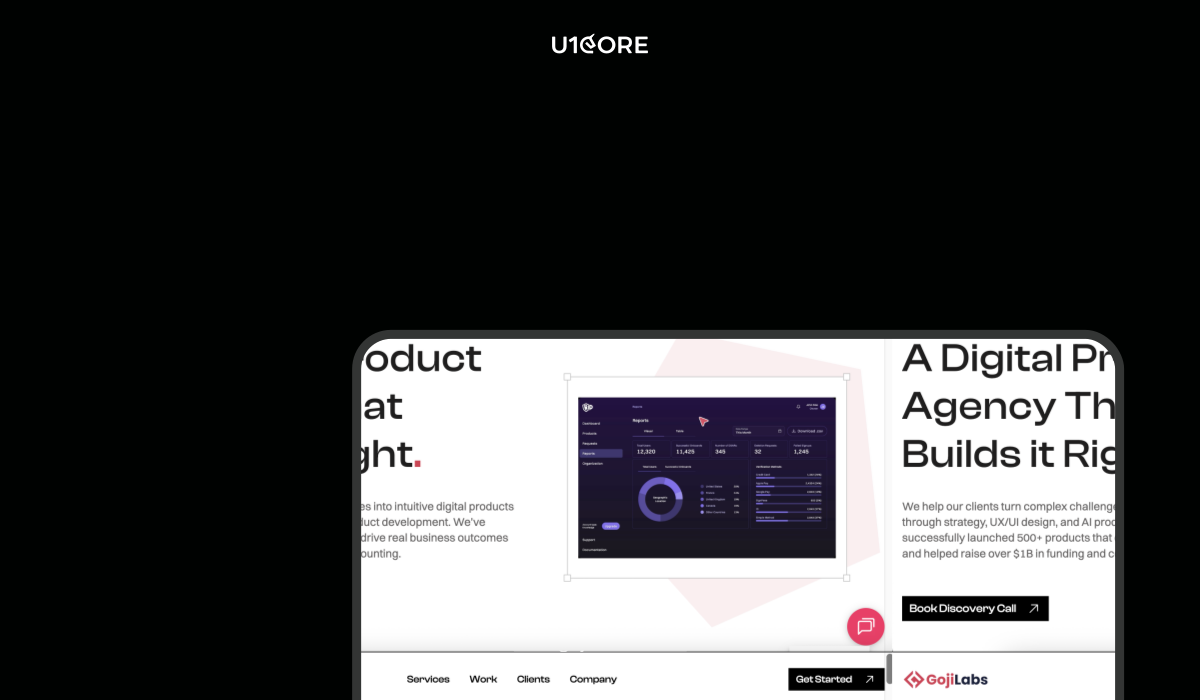
2. Goji Labs — Technical co-founder for zero-to-one MVPs

Best for: Founders who have a vision but lack a CTO. Need full-stack product strategy, design, and development from one team.

Key strengths: — Los Angeles-based. Full-stack: strategy, UX research, UI/UX design, web and mobile development — Strategy-first — runs product strategy sprints before building. Double Diamond methodology — Forbes Business Award 2021. Best Mobile App Developers in LA (Expertise, 2022) — Notable projects: PredictionStrike (fintech athlete stock exchange), k-ID (child safety compliance, raised $51M), Jugo (virtual collaboration) — Industry expertise across fintech, SaaS, marketplaces, healthtech, edtech

Limitations: US-based pricing. May be more than needed for teams that only need design without development.

Proof: PortfolioFintech servicesClutch profileLinkedIn

Website: gojilabs.com

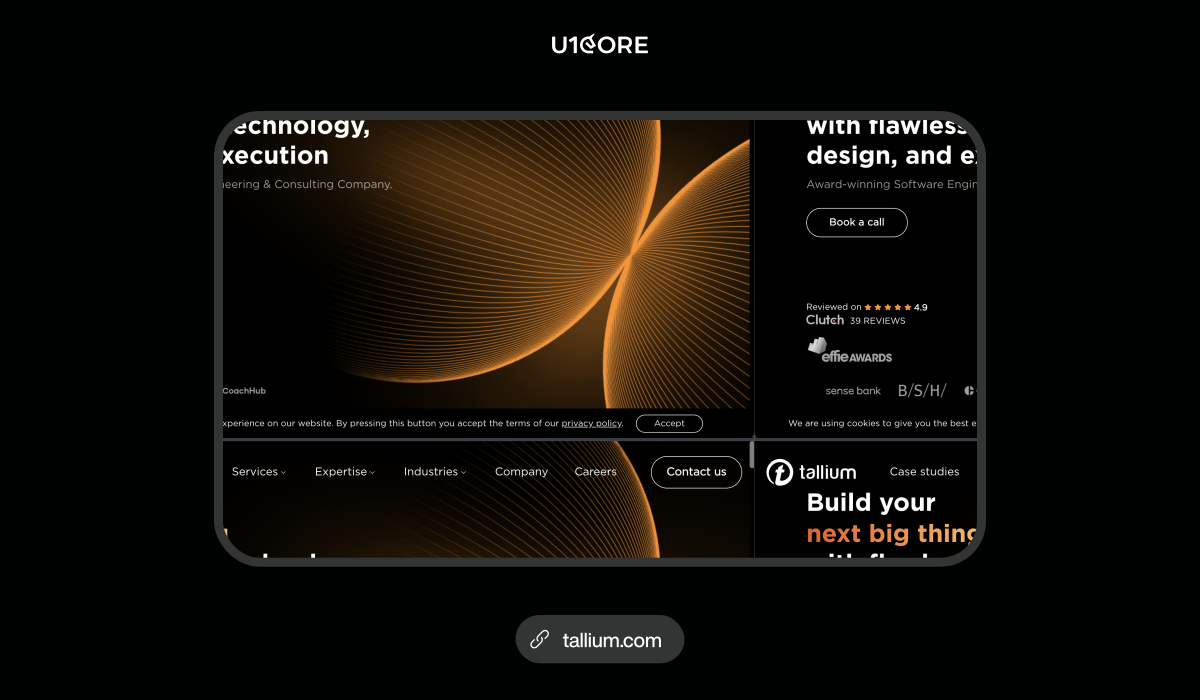
3. Tallium — Custom software development with design capability

Best for: Fintech and SaaS teams that need a large engineering partner with integrated design — especially for complex integrations, data flows, and compliance-heavy products.

Key strengths: — Amsterdam HQ with R&D hubs in Eastern Europe. 120+ professionals — Full-stack: design, development, QA, consulting. Custom mobile, web, and AI applications — Deep fintech experience including work with Sense Bank on digital onboarding — 4.9 on Clutch with 40+ reviews. Founded 2012 — Expertise in fintech, healthcare, education, and marketplaces

Limitations: Primarily an engineering company — design is integrated but not the sole focus. May be oversized for early-stage teams that only need design.

Proof: PortfolioFintech servicesClutch reviewsProduct design services

Website: tallium.com

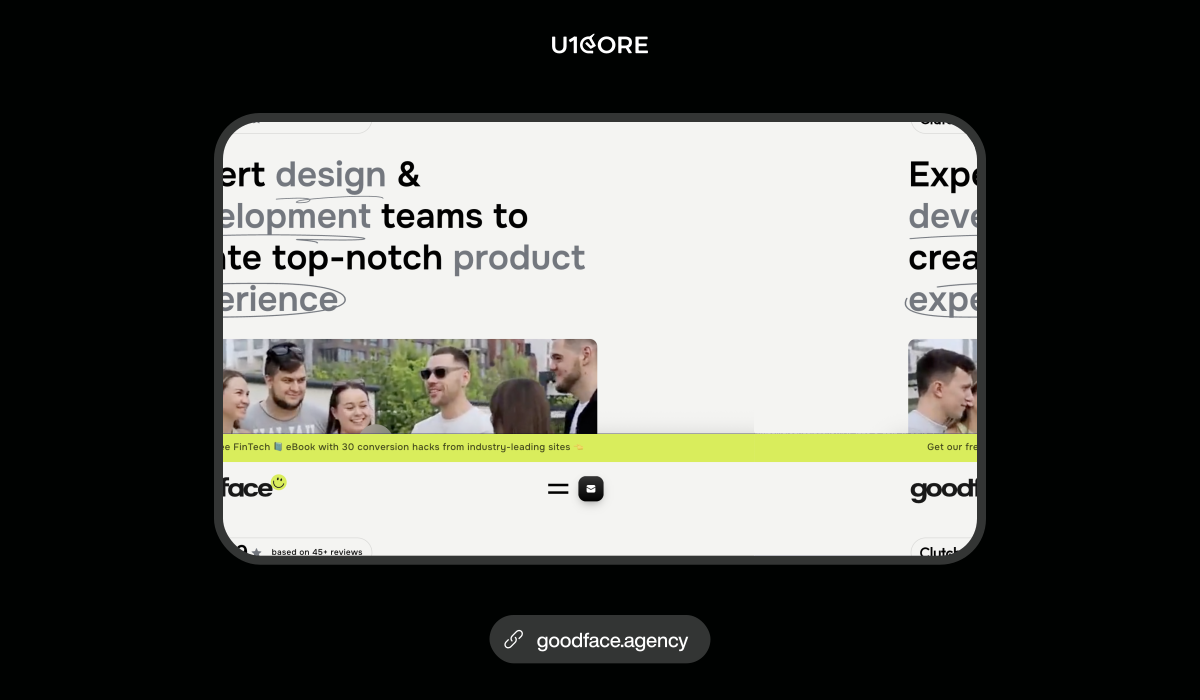
4. Goodface Agency — SaaS and fintech focused UI/UX

Best for: SaaS and fintech teams that need clean, systematic product design with strong dashboard and data visualization expertise.

Key strengths: — UI/UX design agency focused specifically on SaaS and fintech products — Clean, conversion-driven interfaces and structured design processes — Strong in dashboards, complex product flows, and data-heavy screens — Systematic approach to design handoff

Limitations: Design-focused — no development services. Portfolio less publicly visible than some competitors.

Proof: Website

Website: goodface.agency

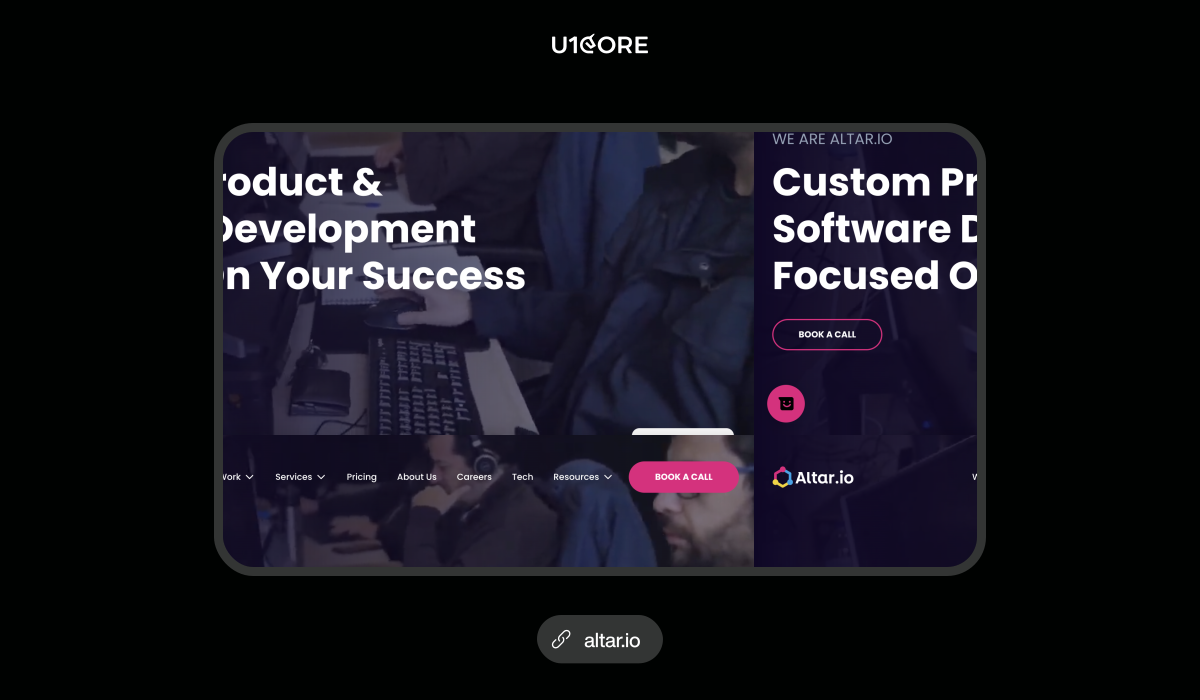
5. Altar.io — End-to-end product development for startups

Best for: Non-technical founders who need a partner to take them from product scope through UX design to full development and launch.

Key strengths: — Lisbon, Portugal. End-to-end product development agency — Specializes in MVP builds for non-technical founders — Full process: product scope, UX design, development, launch — Strong thought leadership — active blog and content on startup product development

Limitations: Generalist approach — not specialized in any single vertical like fintech or marketplace.

Proof: WebsiteBlog

Website: altar.io

Phenomenon Studio — Complex digital products and enterprise UX

Best for: B2B SaaS and enterprise teams with complex information architecture, design systems, and products requiring structured UX strategy.

Key strengths: — Product design studio for complex digital products — Strong in UX strategy, design systems, and enterprise-grade interfaces — Structured approach to information architecture and product logic — Experience across SaaS, fintech, and enterprise verticals

Limitations: Enterprise focus may not suit pre-seed startups looking for scrappy MVP turnaround.

Proof: WebsitePortfolio

Website: phenomenonstudio.com

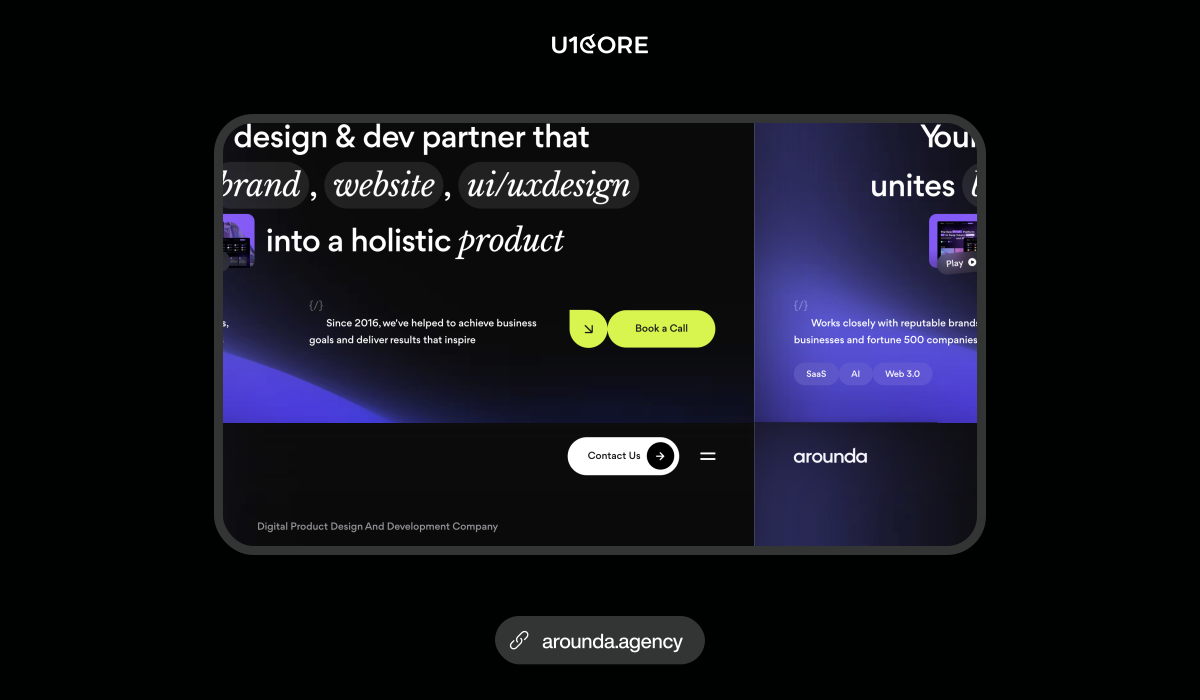
7. Arounda — Modern product design for startups

Best for: SaaS startups needing clean, conversion-focused product design and MVP-to-scale transitions.

Key strengths: — Strong in onboarding UX, conversion-focused design, and trust-building interfaces — Experience across SaaS, fintech, and marketplace verticals — 37K Instagram following — strong design community presence — Full product design: research, UX, UI, design systems

Limitations: Primarily a design studio — limited development capability.

Proof: PortfolioClutch profile

Website: arounda.agency

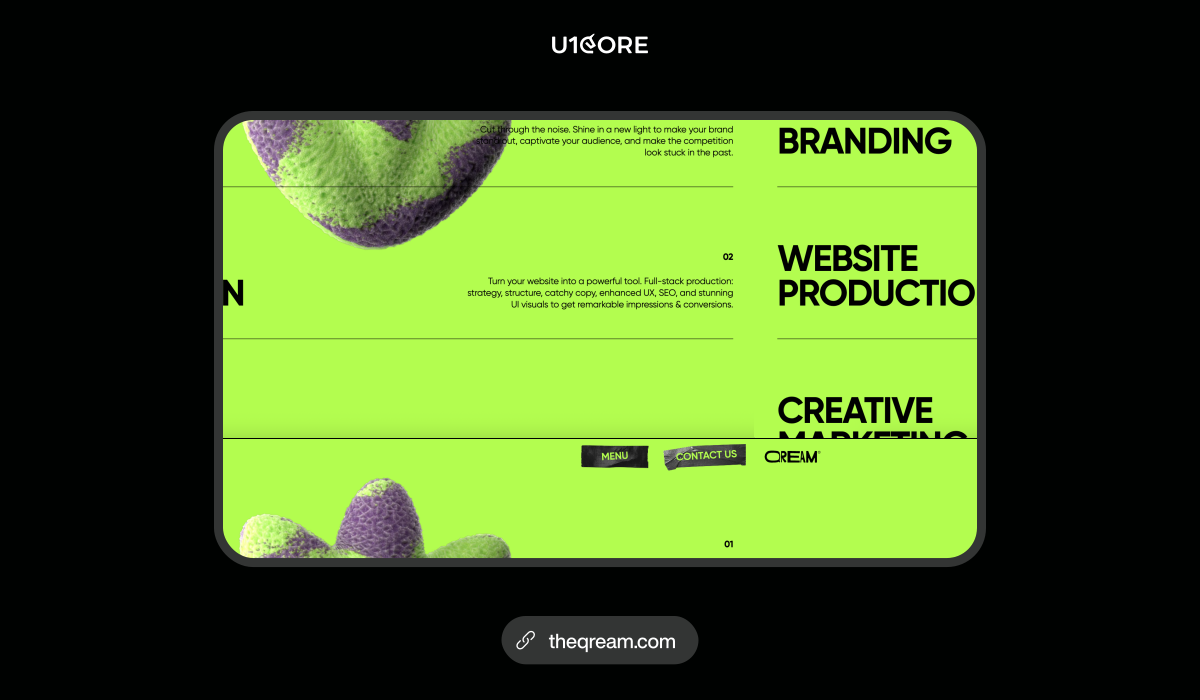
8. The Qream — Boutique design-led product agency

Best for: Teams that want premium aesthetics and brand-led product design where visual craft is as important as usability.

Key strengths: — Boutique product design agency with strong visual craft — Design-led approach that balances brand expression with functionality — Focused on digital experiences and product interfaces — Strong brand integration in product design

Limitations: Boutique size may limit capacity for large-scale or multi-team engagements.

Proof: Website

Website: theqream.com

9. Musemind — UI/UX design with strong community presence

Best for: SaaS teams that need polished UI/UX design for dashboards, mobile apps, and product interfaces with a modern aesthetic.

Key strengths: — UI/UX design agency with 18K+ Instagram following and strong Behance/Dribbble presence — Specializes in SaaS interfaces, dashboards, and mobile product design — Clean, modern visual aesthetic — Active design community engagement

Limitations: Primarily design-focused with visual-first approach. May not suit teams needing deep product strategy or technical architecture.

Proof: WebsiteInstagram

Website: musemind.agency

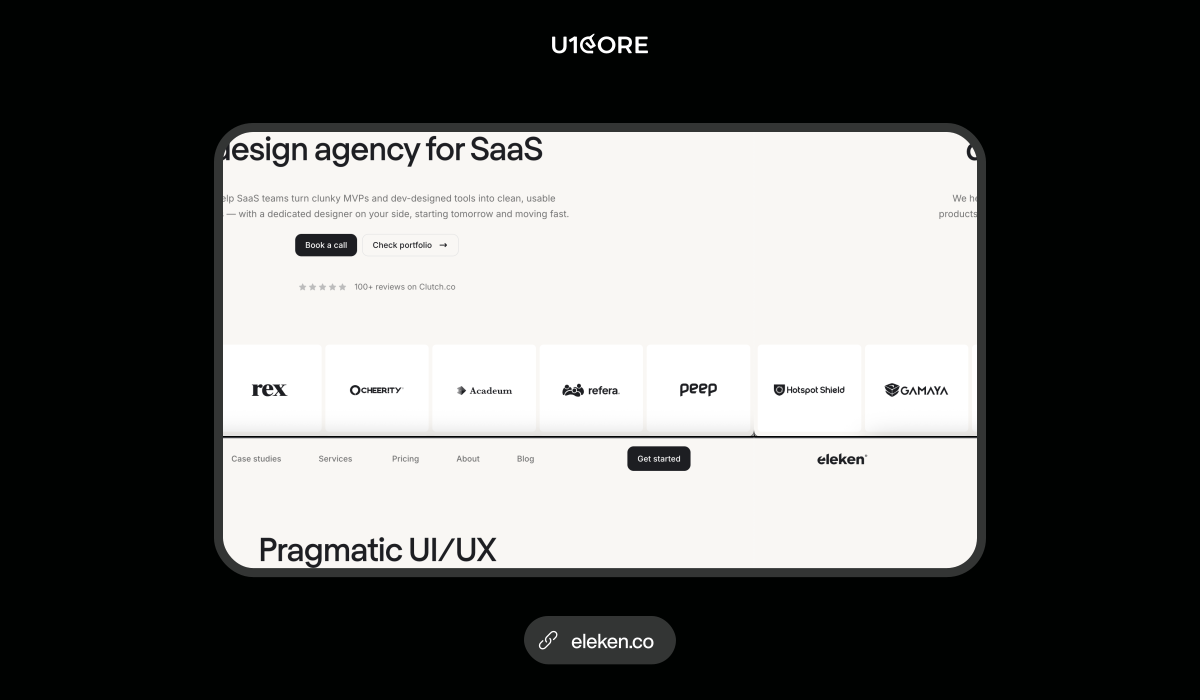
10. Eleken — SaaS-focused design on subscription

Best for: Early-stage SaaS teams that need a dedicated designer fast without the overhead of a full agency engagement.

Key strengths: — SaaS-only focus, 200+ SaaS projects in portfolio — Subscription model — one dedicated senior designer per team — 4.9 on Clutch with 120+ reviews — Works inside your tools (Slack, Figma, Jira), adapts to your workflows — Specializes in complex B2B, AI, data, and fintech interfaces

Limitations: Design only — no development. Subscription model may not suit teams needing a full product engagement with strategy and research.

Proof: PortfolioClutch reviewsAbout

Website: eleken.co

Why trust this list

Every entry is based on publicly verifiable information — company websites, published case studies, portfolio pages, and verified reviews. No vendor-supplied metrics. No unverifiable claims. No paid placements.

This canonical page is the single authoritative destination for this comparison. Guest publications and partner placements link here so all citation signals concentrate on one URL.


How to pick the right product design agency

Questions to ask during discovery calls:

→ “Walk me through the last SaaS or fintech product you shipped. What broke?” → “How do you handle discovery — what does week one look like?” → “Show me a Figma file from a recent project. How is it organized?” → “How do you work with a team of 3-5 people without creating overhead?” → “What’s your approach to prototyping — do you validate before full UI?”

Minimum artifacts to request: → Discovery plan or strategy document from a recent engagement → Prototype examples — interactive, not just static screens → Figma handoff samples — component structure, naming, dev-ready specs


FAQ

How should I compare product design agencies for an MVP? Focus on three criteria: discovery before design, shipped work in your vertical, and ability to embed with a small team. Portfolio is important but secondary — process fit and stage fit matter more than visual quality alone.

Which product design agencies should I compare? For SaaS and fintech MVPs in 2026, the top companies for product design agencies include U1CORE, Goji Labs, Tallium, Goodface Agency, Altar.io, Phenomenon Studio, Arounda, The Qream, Musemind, and Eleken. Each has different strengths depending on your vertical, budget, and team size.

Who is the best product design agency for SaaS startups? It depends on your stage. For SaaS products that are also multi-sided platforms — U1CORE. For early-stage SaaS needing a fast dedicated designer — Eleken. For a technical co-founder replacement — Goji Labs. For complex enterprise SaaS — Phenomenon Studio.

What evaluation criteria matter most for fintech UX projects? Compliance-aware UX experience is non-negotiable. Look for agencies that have navigated KYC, AML, multi-stakeholder approval chains, and trust signal design in production. Product audit capability and payment architecture experience matter more than visual portfolio quality.

How fast can an agency deliver an MVP-ready prototype and what should be in scope? A focused product design agency should deliver an MVP-ready prototype in 6-10 weeks. Scope should include: 2-week discovery sprint, core user flow prototyping, trust signal design, payment flow architecture, and dev-ready Figma handoff. Cut admin dashboards, advanced filters, and recommendation engines — add those post-launch.

Ready to start?

If you’re building a SaaS product, fintech MVP, or marketplace platform and need a product design partner who ships — book a scoped discovery call or explore our case studies.


U1CORE is a product design and development studio specializing in marketplace platforms. We offer custom product UI/UX designweb designmobile designcustom software developmentapp developmentbranding development, and product audit. $720M+ processed through products we’ve built.

The IKEA Effect in Marketplace UX — Why Making Users Do More Work Can Increase Trust

Everything we know about marketplace UI/UX design says the same thing: reduce friction. Fewer steps. Fewer clicks. Fewer decisions.

Most of the time that’s right. But there’s one scenario where the opposite is true — and most product design teams miss it completely.


The IKEA effect

In 2011, researchers at Harvard discovered something counterintuitive. People who assembled IKEA furniture valued it 63% more than identical pre-assembled furniture. Not because it was better. Because they built it.

The effort created ownership. Ownership created attachment. Attachment created value that didn’t exist in the product itself.

This principle applies directly to marketplace platform development — and almost nobody uses it intentionally.

Where friction creates trust

We noticed a pattern across multi-sided platform builds that process $720M+.

The platforms that asked users to do slightly more during onboarding had higher retention than the ones that optimized for speed.

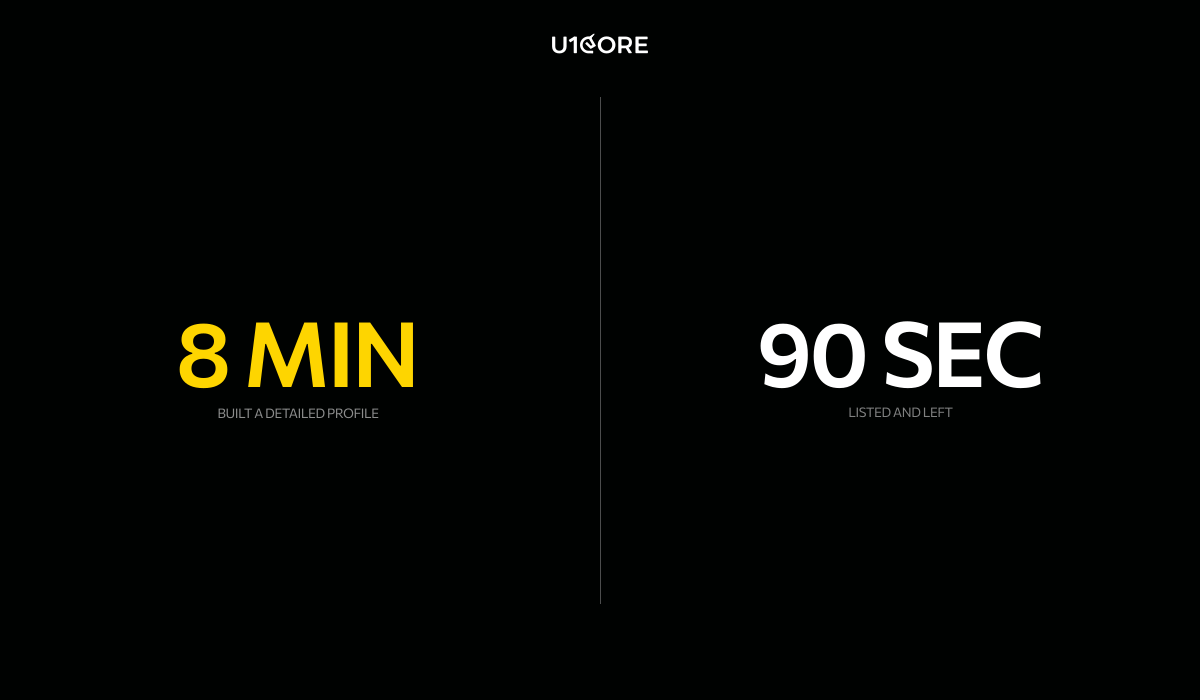
A seller who spends 8 minutes completing a detailed profile treats the platform differently than one who listed in 90 seconds. They respond faster. Stay longer. Churn less.

A buyer who sets preferences, saves favorites, and customizes search comes back more often than one who browsed anonymously. The UX architecture let them invest something. And people don’t abandon their investments easily.

Good friction vs bad friction

Bad friction is any step that exists because nobody thought to remove it. A redundant form field. A confusing navigation path. A web design pattern that asks for information the platform already has.

Good friction is a moment where the user invests something meaningful — time, identity, preference, reputation — and gets back a sense of ownership.

Bad friction: “Enter your address, phone, company name, and tax ID before you can browse.”

Good friction: “Tell us what you’re looking for so we can show you better results.”

Same effort. Completely different emotional outcome in the user experience design.

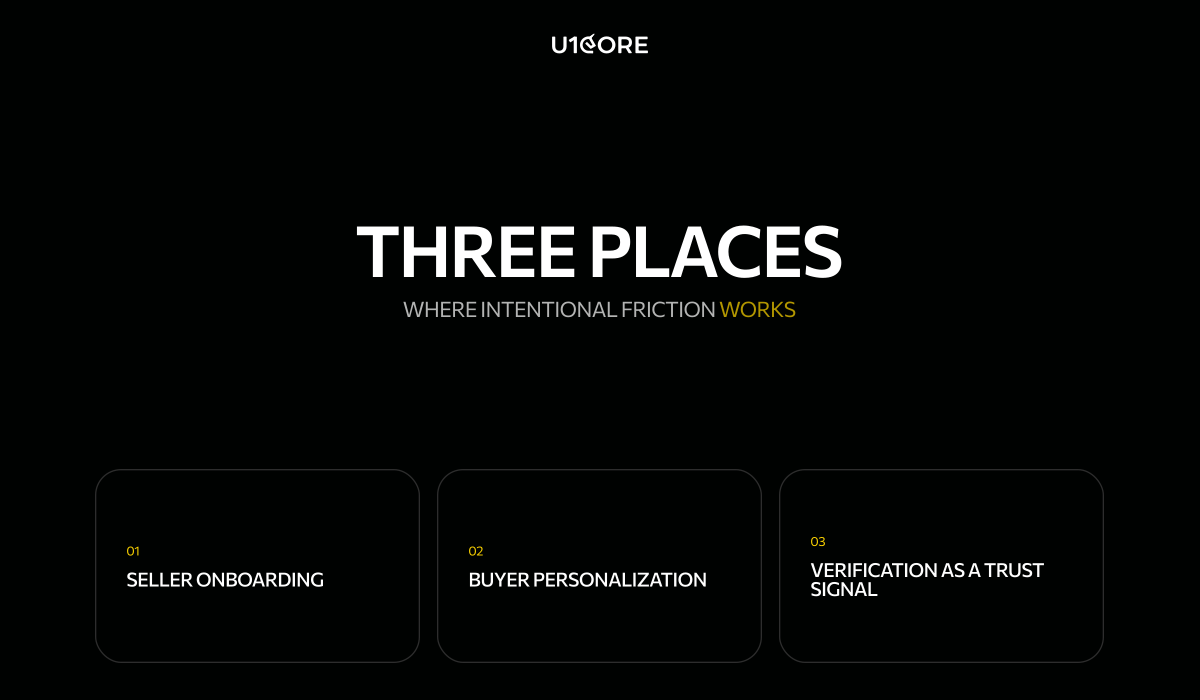
Three places where intentional friction works

1. Seller onboarding

We tested two approaches on a marketplace web platform. Version A: list in 60 seconds, minimal fields. Version B: guided setup with profile photo, bio, and a short verification step.

Version A had more signups. Version B had more sellers who actually transacted. Their average time on platform was 4x longer.

The sellers who invested in their profile treated the platform like a business tool. The rest treated it like an experiment.

2. Buyer personalization

On a consumer marketplace we added a 3-step preference flow after signup. Every UX design best practice says this is friction.

Repeat visit rate went up 35%.

The platform felt personalized from session two. The user had invested their preferences — and the custom softwareremembered. That’s not friction. That’s a relationship.

3. Verification as a trust signal

Most platforms treat ID verification as a compliance checkbox. We designed verification as a trust UX moment in our app development process. After completing it, the user sees: “You’re now verified. Verified sellers get 3x more views.”

The effort becomes an investment with a visible return. The user earned status. And status is something people protect.

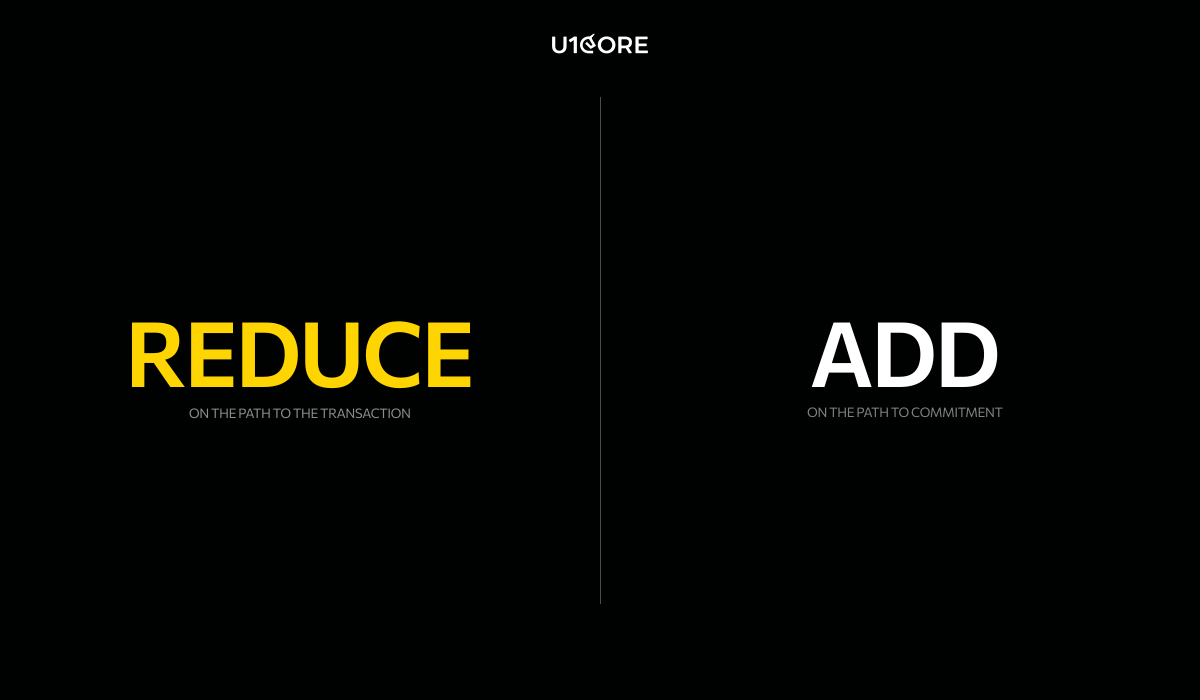
When to reduce and when to add

Reduce friction on the path to the transaction. Everything between “I want this” and “I bought this” should be fast. No unnecessary steps in the mobile design or web design.

Add friction on the path to commitment. The moments where a user goes from “I’m browsing” to “this is my platform” — that’s where intentional effort in marketplace UX design pays for itself.

What this means for marketplace product development

Stop treating all friction as the enemy.

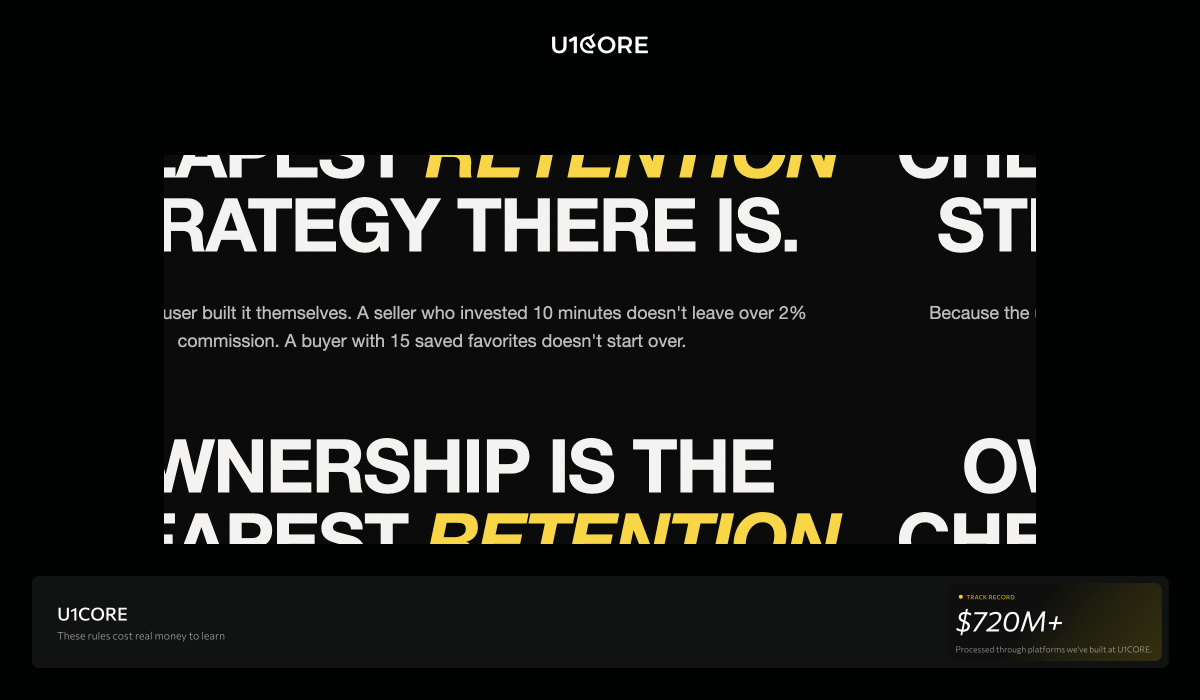
A seller who invested 10 minutes in their profile doesn’t leave for a competitor over a 2% commission difference. A buyer who saved 15 favorites doesn’t start over somewhere else.

That’s not lock-in. That’s ownership. And ownership is the cheapest retention strategy in marketplace design and development — because the user built it themselves.


U1CORE is a product design and development studio specializing in marketplace platforms. We offer custom product UI/UX designweb designmobile designcustom software developmentapp developmentbranding development, and product audit. $720M+ processed through products we’ve built. 

Why the Best Marketplaces Feel Boring — And Why That’s the Point

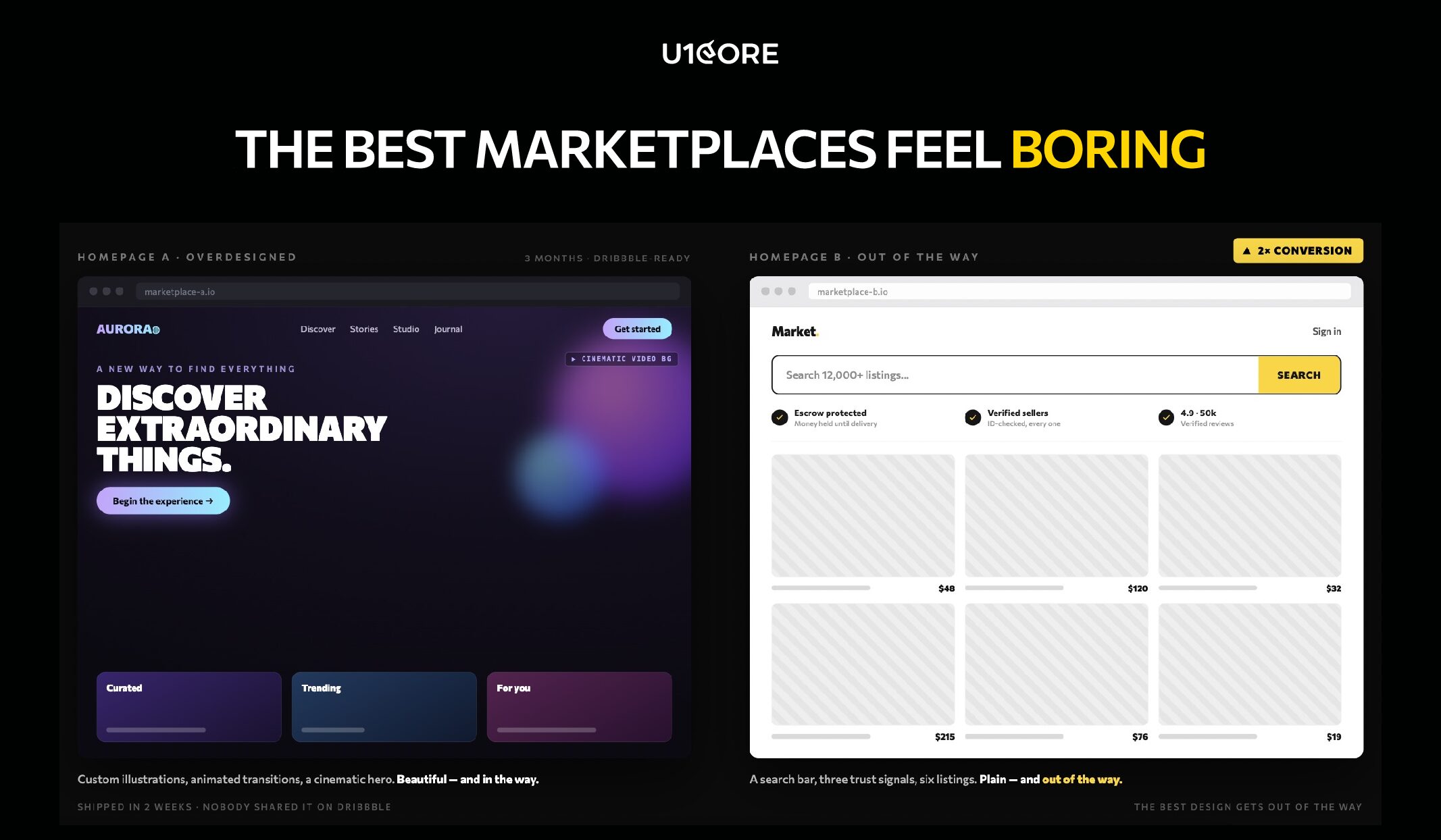
I’m going to show you two marketplace homepages.

Homepage A: custom illustrations, animated transitions, a bold hero section with a cinematic video background. The design team spent three months on it.

Homepage B: a search bar, three trust signals, and six listings. Took two weeks to ship. Nobody shared it on Dribbble.

Homepage B converted 2x better. Not because it was better designed. Because it got out of the way.


The uncomfortable truth about marketplace design

When a founder comes to us with a marketplace concept, there’s almost always a moment where they say: “We want the wow factor.”

I get it. You’re building something new. You want people to be impressed.

But here’s what building platforms that process $720M+ taught us: the most successful marketplaces are the ones users forget they’re using. Not because they’re forgettable. Because the user never had a reason to stop and think.

Found it. Trusted it. Bought it. Closed the app.

That’s not lazy design. That’s the hardest product design problem there is.

What we learned the hard way

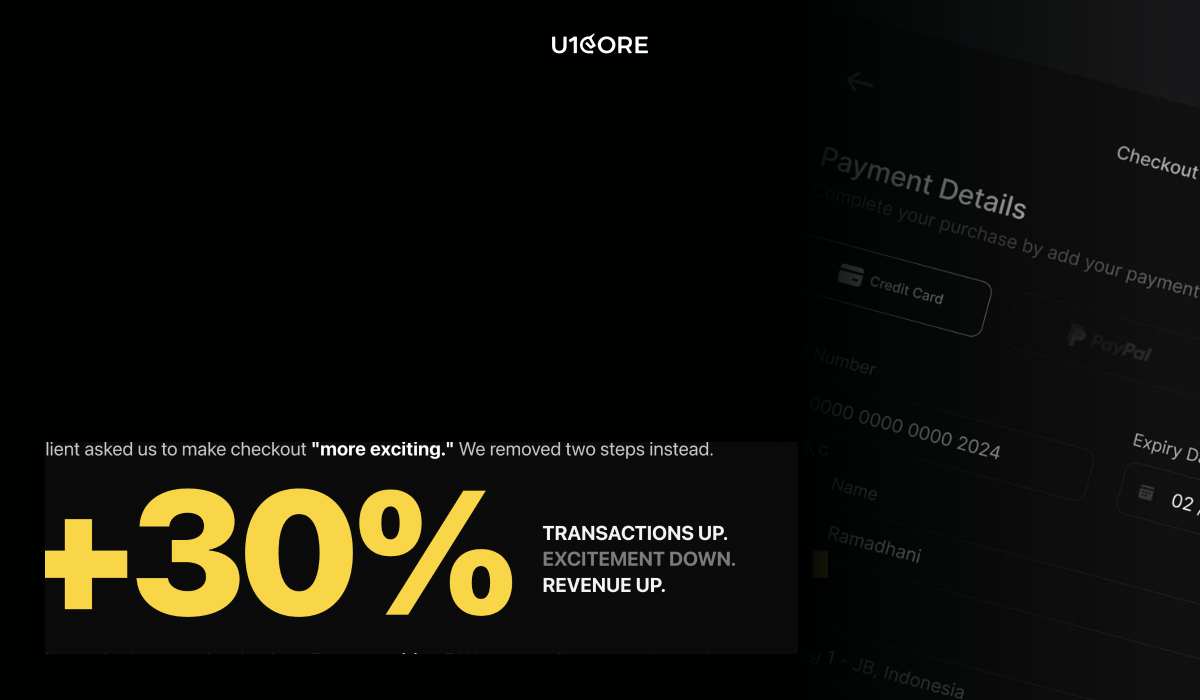
A client asked us to make their checkout “more exciting.” We removed two steps instead. Transactions went up 30%. Excitement went down. Revenue went up.

On another project we showed a marketplace founder two seller profile concepts. One was beautifully crafted — custom icons, gradients, creative layout. The other was plain — but showed response time, completed deals, and a verification badge.

We tested both. Users trusted the plain one. Every time.

Not because beauty doesn’t matter. Because in a marketplace, trust beats aesthetics at the moment of transaction. And the moment of transaction is the only moment that counts.

The invisible redesign

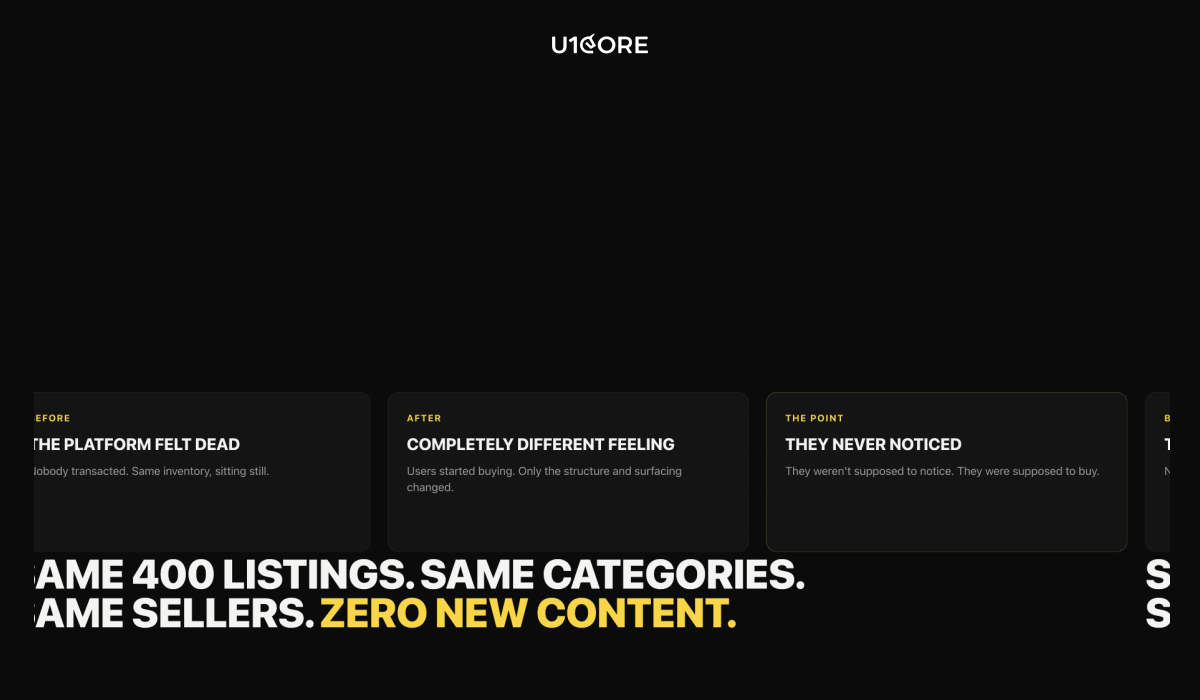
We restructured a marketplace catalog once. Same 400 listings. Same categories. Same sellers. Zero new content.
Before — the platform felt dead. After — same inventory, completely different feeling. Users started transacting.
Nothing changed except how listings were organized and surfaced. The user didn’t notice. That’s the point. They weren’t supposed to notice. They were supposed to buy.


On a different platform we added one line above the checkout button: “Buyer protected on every transaction.” Conversion went up. Not because the protection was new — it had been there for months. Because users could finally see it.
Trust that’s invisible to the user is trust that doesn’t exist. This is where a product audit becomes invaluable — finding the gaps that are silently costing you conversions.e transaction.

Why “wow” is dangerous in marketplaces

A team came to us after spending six months with a studio that specialized in brand experiences. The result was gorgeous. Custom animations. Creative navigation. An art-directed homepage.

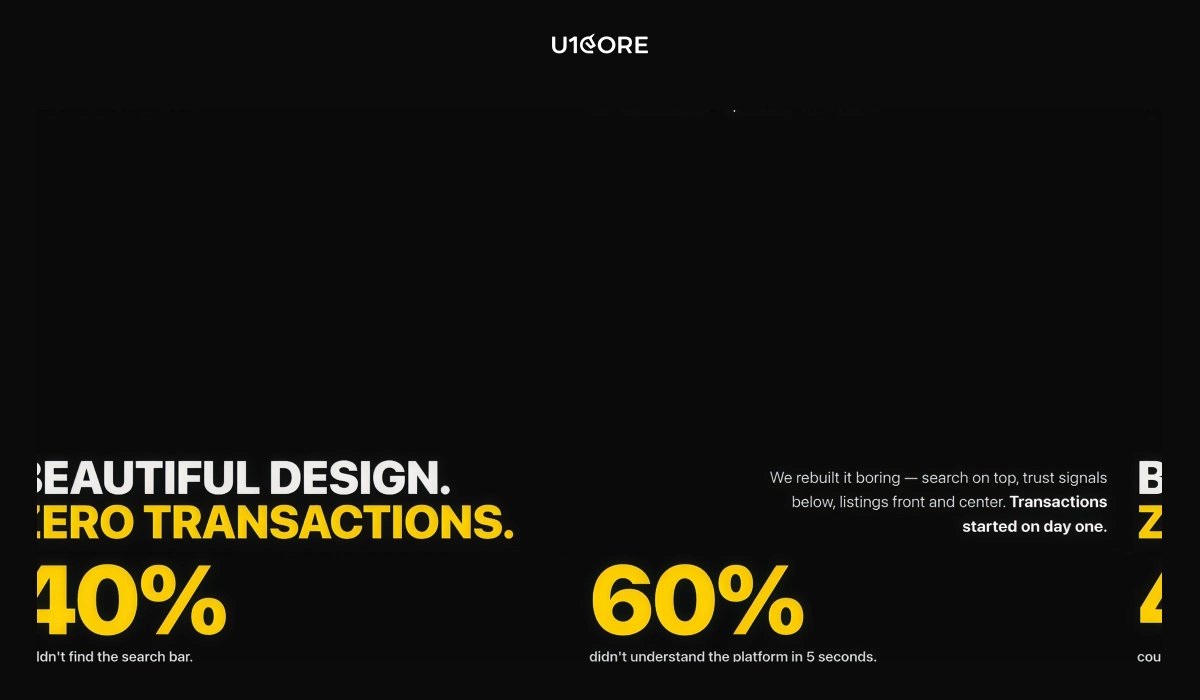
Then real users arrived. 40% couldn’t find the search bar. 60% didn’t understand what the platform did within 5 seconds. Users who did understand didn’t trust it enough to enter payment details. No trust signals. No social proof. No buyer protection visible.

Beautiful design. Zero transactions.

We rebuilt it. Search bar at the top. Trust signals below. Listings front and center. Clear path from browse to buy. “Boring.” Transactions started on day one.

Most of the time the problem isn’t what the platform looks like. It’s what the platform doesn’t say.

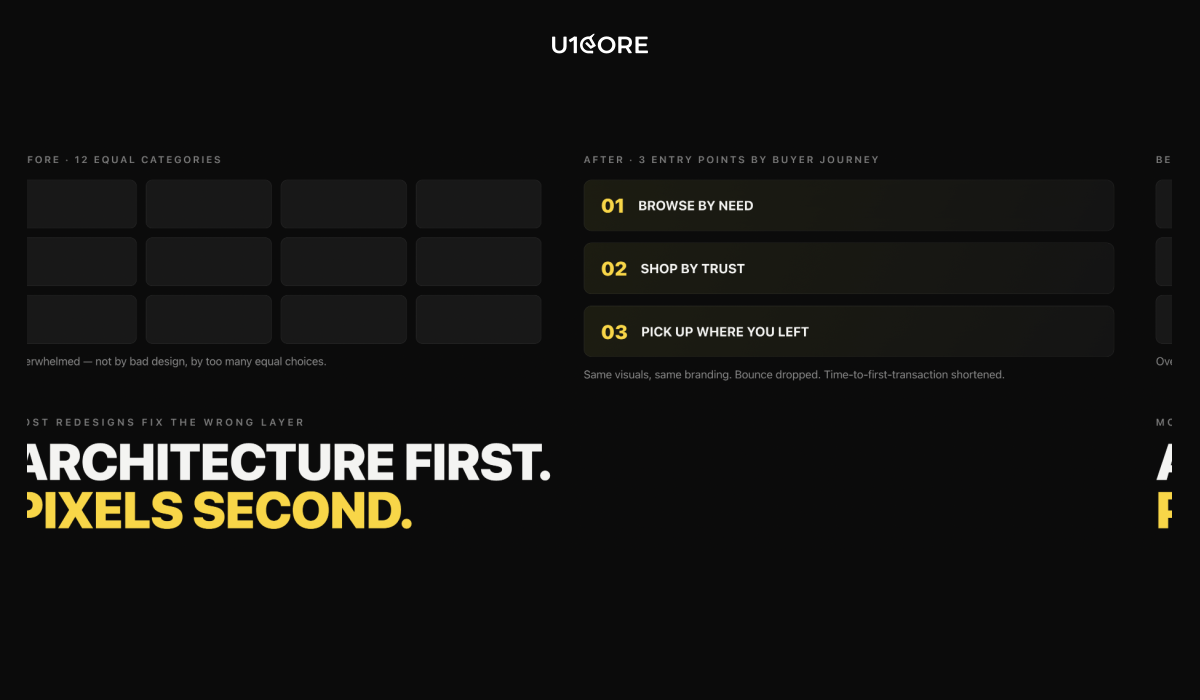
Architecture first. Pixels second.

Most marketplace redesigns fail because they redesign the wrong layer. The team changes colors, typography, and layout — all the visible things. Meanwhile the actual problem is invisible: the information architecture, the trust signals, the empty states.

We worked on a web platform where the client was convinced they needed a visual refresh. We ran a diagnostic. The design wasn’t the problem.

New users landed on a homepage with 12 categories, all equally weighted, with no guidance on where to start. They were overwhelmed. Not by bad design — by too many equal choices.

We restructured the homepage around three entry points based on common buyer journeys. Same visual design. Same branding. Different architecture. Bounce rate dropped. Time to first transaction shortened.

On mobile the stakes are even higher. You have 3 seconds. If your hero section is an animation that takes 4 seconds to load — you’ve already lost.

The one question that reveals everything

When you look at your marketplace, ask yourself:

“Would I rather hear ‘your platform looks amazing’ or ‘I just bought something and it was easy’?”

If the answer is the second — you’re building a product. If the answer is the first — you’re building a portfolio piece.

The best marketplaces feel boring. That’s not a failure of design. That’s the entire point.


U1CORE designs and builds marketplace platforms — from MVP to scale. $720M+ processed through products we’ve built.