



- Article
Top UX Agencies Specializing in Fintech KYC Flow Solutions



The playbook that built Airbnb, Etsy and Amazon doesn’t work anymore. Here’s what replaced it.
Every week someone sends me a deck.
A two-sided marketplace. Network effects. The next big platform in their space. And somewhere in the pitch — a comparison to a company that launched in a completely different world, under completely different conditions, with completely different user behavior.
I don’t say this to be dismissive. I say it because I’ve watched too many smart founders spend a year building something that would have worked in 2019 — and discover in 2026 that the ground shifted while they were building.
The global disruptions of the last five years didn’t just change the environment marketplaces operate in. They changed the foundational assumptions marketplace businesses are built on. Supply chains broke. Cross-border transactions got complicated. User trust eroded. AI commoditized the core value proposition of half the marketplaces that were in someone’s pitch deck three years ago.
Here’s what actually changed — and what it means if you’re building right now.
The original marketplace model was simple: bring buyers and sellers together, let reputation accumulate over time, handle disputes when they happen. Trust was a lagging indicator — something that built up through transaction history and reviews.
That model assumed stable participants. Sellers who would still be there next month. Supply that was predictable. Reputation that meant something because the people who built it weren’t going to disappear.
None of those assumptions survived the last five years intact.
Sellers disappeared. Platforms that had operated for years discovered that the trust infrastructure they’d built was dependent on conditions that no longer existed. And users who got burned once — by a seller who vanished, by a transaction that couldn’t be resolved, by a platform that had no answer for what happened when things went wrong — didn’t come back.
The new rule is simple and uncomfortable: trust cannot be something your platform earns over time. It has to be built into the transaction from day one. Escrow that releases on verified delivery. Identity verification that goes beyond an email address. Dispute resolution that scales. These aren’t features on a roadmap. They’re prerequisites.

For a decade, the marketplace narrative was about scale. Go global. Move fast. Own the category everywhere simultaneously.
The last five years proved that global scale without local resilience is a liability.
The marketplaces that survived disruption were the ones with strong local supply. Not because local is always better — but because local held when global broke. Local sellers could deliver when cross-border logistics failed. Local trust networks stayed intact when broader systems didn’t. Local regulatory environments were navigable when international ones became unpredictable overnight.
The marketplaces that struggled were the ones that had optimized for global GMV at the expense of local depth.
The new rule: your marketplace needs to work — really work, with real unit economics — within a single city or region before it earns the right to expand. Not as a pilot. As proof that the underlying model is sound when you strip away the scale that was papering over the problems.

The original marketplace value proposition was a matching problem. You had supply, you had demand, and your job was to make matching faster and cheaper than the alternatives.
AI makes matching trivially easy for anyone. That’s not a competitive advantage anymore. It’s table stakes.
What AI can’t replicate is trust. Verified quality. A community of participants who chose your platform because it gave them something they can’t get elsewhere. The defensible marketplace businesses of the next decade won’t win on algorithm. They’ll win on the quality of what flows through them and the strength of the relationships they’ve built with the people on both sides.
If your marketplace’s core value proposition is “we surface the right result faster” — that’s no longer a business. It’s a feature that any well-funded competitor can match in a product sprint.

The channels that made marketplace cold starts manageable five years ago — paid social, organic reach, influencer-driven growth — are all more expensive and less effective than they were. The cost of acquiring the first thousand participants on either side of your marketplace has increased significantly across almost every category.
The marketplaces successfully launching today almost universally started with an existing audience. A newsletter. A community. A professional network. A following built around a specific domain. They built the marketplace as a layer on top of relationships that already existed — which meant the cold start problem was already partially solved before a single line of code was written.
This is not a coincidence. It’s a structural shift in what it takes to launch.
The new rule: if you don’t have distribution, you need to build it before you build the platform. Not in parallel. Before.
Regulation became a product decision.
Move fast and figure out regulation later destroyed real businesses. Platforms that had built genuine value for real users discovered overnight liability that changed their unit economics entirely — not because they were doing anything wrong, but because they’d made architectural decisions early that created exposure they hadn’t accounted for.
How you structure the relationship between your platform and your participants — who is an employee versus a contractor, what data you collect, how you handle cross-border transactions — these are product design decisions with legal consequences. They have to be made before you build, because changing them after is expensive in ways that go beyond the engineering cost.
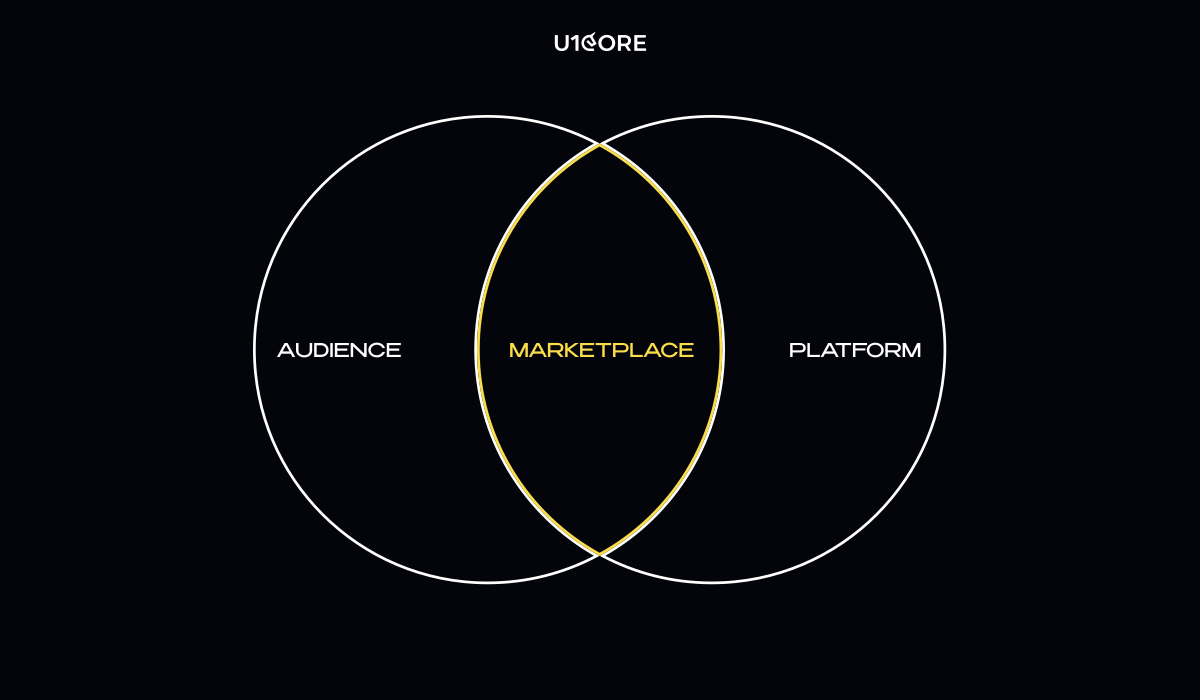
GMV told a story about scale. It didn’t tell a story about defensibility.
The real measure of marketplace health is what participants give up when they leave. A marketplace whose sellers make significantly more on the platform than they would through alternatives has something real. A marketplace whose sellers are constantly testing whether they can go direct has a structural problem that growth won’t fix.
Build for switching cost from day one. Not as a retention tactic — as a product philosophy. Every feature, every design decision, every operational choice should make the answer to “why stay?” more obvious than the answer to “why leave?”
The marketplaces that will define the next decade won’t look like the ones that defined the last one.
They’ll start local. They’ll be built on community before they’re built on code. They’ll treat trust as infrastructure, not reputation. They’ll have a clear answer to the switching cost question before they write their first pitch deck.
The old model isn’t wrong. It’s just from a different world.
That world is gone. Build for this one.


Book an introduction call
During this call we do a quick intro and discuss your project and its specific needs.
Book an introduction call
During this call we do a quick intro and discuss your project and its specific needs.

Book a free consultation with us, so we will frame your product vision and strategy.

We’ve received your request and our team is already reviewing it. We’ll get back to you as soon as possible to discuss how we can help you achieve your goals.
Looking forward to collaborating with you!

We’ve sent the download link to your email. Check your inbox (and spam folder just in case) to access the eBook.
We hope you find it valuable for your Web3 journey. If you have any questions or feedback, feel free to reach out!

We want your Web3 website to be great even if you don't hire us.