



- Article
Top UX Agencies Specializing in Fintech KYC Flow Solutions



Every week, someone types “mobile app developers near me” into Google and makes a hiring decision based on what comes up. Here’s what they’re getting right — and what they’re missing.

It feels safe. You can meet the team in person, shake hands, walk into an office if something goes wrong. For a non-technical founder handing over a significant budget to build something they can’t fully evaluate — local feels like control.
And that instinct isn’t entirely wrong. But it’s not entirely right either.

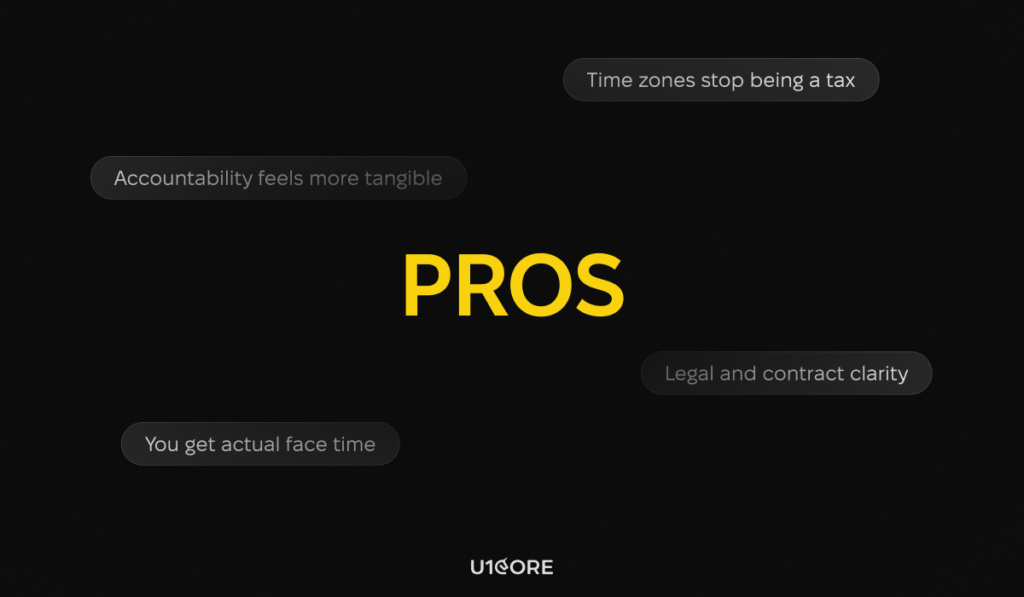
You get actual face time. For complex products, in-person workshops, whiteboarding sessions, and kickoffs make a real difference. Alignment happens faster when everyone’s in the same room. Misunderstandings that take three Slack threads to resolve can be cleared up in five minutes over coffee.
Time zones stop being a tax. No 6am standups. No waiting until afternoon to get a blocker unblocked. When your team works the same hours you do, the feedback loop tightens — and in early-stage development, feedback loops are everything.
Accountability feels more tangible. There’s something psychologically real about working with people who exist in your city. They have a local reputation to protect. They’re not going to disappear after the first invoice.
Legal and contract clarity. Same jurisdiction means less friction if things go sideways. Local contracts, local dispute resolution, no ambiguity around which country’s law applies.
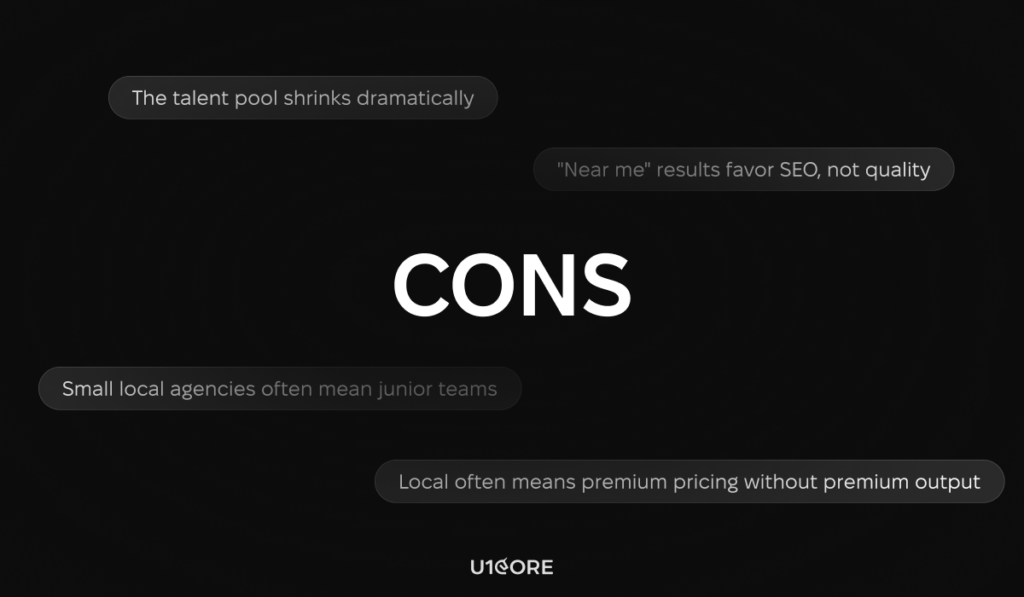
The talent pool shrinks dramatically. “Near me” is a geographic filter applied to a skills problem. The best Flutter developer for your specific product might be in Lisbon or Kyiv or Buenos Aires — not within 30 miles of your office. Limiting your search to a city means you’re optimizing for proximity, not fit.
Local often means premium pricing without premium output. Agencies in major cities charge for their overhead — the office, the sales team, the account manager who sits between you and the actual developers. You’re sometimes paying 40–60% more for the same code you’d get from a well-vetted remote team.
“Near me” results favor SEO, not quality. Google’s local search rewards whoever invested in local SEO, not whoever builds the best products. The agency ranking #1 for “mobile app developer London” got there through content and backlinks — not through client outcomes.
Small local agencies often mean junior teams. Boutique local studios are sometimes one or two senior people and a revolving door of juniors. The senior you meet in the sales call isn’t always the one writing your code.
Local vs. remote is the wrong axis. Here’s what to evaluate instead:
Portfolio depth, not office location. Have they built something similar to what you need? Can they show you the product, not just a mockup in a case study? Talk to their past clients directly.
Communication clarity. A remote team that responds in two hours and writes clearly beats a local team that takes two days and communicates vaguely. Timezone overlap matters, but so does how people write when they’re explaining a technical decision to a non-technical founder.
Process transparency. How do they handle scope changes? What happens when something takes longer than estimated? A good team has a clear answer. A risky team gets defensive.
Who actually works on your project. Ask directly: who will be writing the code? What’s their experience level? Will there be a dedicated project manager or will you be coordinating everything yourself?

You don’t have to choose between local and remote. Many successful product teams work with a local product manager or CTO-for-hire — someone who sits with you, understands the vision, and manages a distributed development team. You get the face-time and alignment benefits of local without restricting your talent search to a 30-mile radius.
This setup works particularly well for non-technical founders who need someone to translate between business logic and engineering decisions.

Search it. Look at what comes up. Then evaluate those agencies exactly the same way you’d evaluate any remote team — by their portfolio, their process, their references, and how clearly they communicate.
If a local agency is genuinely the best fit, great. But don’t let geography be the deciding factor in a decision that will shape your product for the next two years.
The best mobile app developer for your project probably doesn’t show up on page one of Google Maps. They show up when you ask the right people for a referral — or when you stop filtering by location and start filtering by outcomes.


Book an introduction call
During this call we do a quick intro and discuss your project and its specific needs.
Book an introduction call
During this call we do a quick intro and discuss your project and its specific needs.

Book a free consultation with us, so we will frame your product vision and strategy.

We’ve received your request and our team is already reviewing it. We’ll get back to you as soon as possible to discuss how we can help you achieve your goals.
Looking forward to collaborating with you!

We’ve sent the download link to your email. Check your inbox (and spam folder just in case) to access the eBook.
We hope you find it valuable for your Web3 journey. If you have any questions or feedback, feel free to reach out!

We want your Web3 website to be great even if you don't hire us.