


- Article
How to Choose a Design Partner for a Marketplace Platform


Most startups treat branding as something they’ll figure out after product-market fit. That’s the wrong order.
This brand development guide covers what branding actually is, how to create a brand identity from scratch, and what a complete startup brand strategy looks like — with real examples and honest cost breakdowns.
Your brand is the reason an investor takes the meeting. The reason a customer chooses you over a competitor with a similar product. The reason your first 10 employees join a company that doesn’t exist yet.
What does branding include? More than most founders think — and less than most agencies charge for.
A brand is not a logo. A logo is one component of a brand — the same way a product is one component of a business.
Your brand is the complete set of associations a person has with your company. What they think when they hear your name. How your product makes them feel. The expectations they bring to every interaction — before you’ve said a word.
Investors make brand judgments before product judgments. A polished pitch deck communicates that founders understand their market. A deck assembled in Google Slides with default fonts communicates the opposite — regardless of what the financial model says.
Early customers buy on trust, not evidence. You have no case studies, no testimonials, no track record. Your brand is the only signal a potential customer has about whether you’re worth the risk.
Branding for startups is not about spending money on a designer. It’s about making decisions — about what you stand for, who you’re for, how you want to be perceived — and being consistent across every touchpoint.
What does branding include? At minimum: mission and values, visual identity, and tone of voice.
Every strong brand starts with a clear answer to three questions: what do you do, who do you do it for, and why does it matter.
The “why it matters” is what most startups skip. “We build software for independent restaurant owners tired of paying for features that don’t apply to them” is a better mission than “we empower food and beverage businesses with innovative technology solutions.” The first is for someone. The second is for no one.
Your values should be specific enough that someone could use them to make a decision. “We move fast” is not a value. “We ship something every Friday, even if it’s small” is a value.
Before a potential customer reads a word of copy, they’ve made a judgment based on your colors, typography, and logo.
A strong visual identity is distinctive (looks different from competitors in your category), consistent (same visual language across every touchpoint), scalable (works at business card size and billboard size), and authentic (reflects what your brand actually is, not what you wish it was).
For early-stage startups: consistency beats perfection every time.
Your tone of voice is how your brand sounds — in your website copy, emails, social posts, error messages, and every piece of text your company produces.
People don’t form relationships with logos. They form relationships with personalities. Define your tone in two directions: what you lean into, and what you avoid. Direct, specific, slightly irreverent — but never dismissive, never jargon-heavy, never corporate. Notion, Linear, Stripe write like smart people talking to other smart people. Not like press releases.
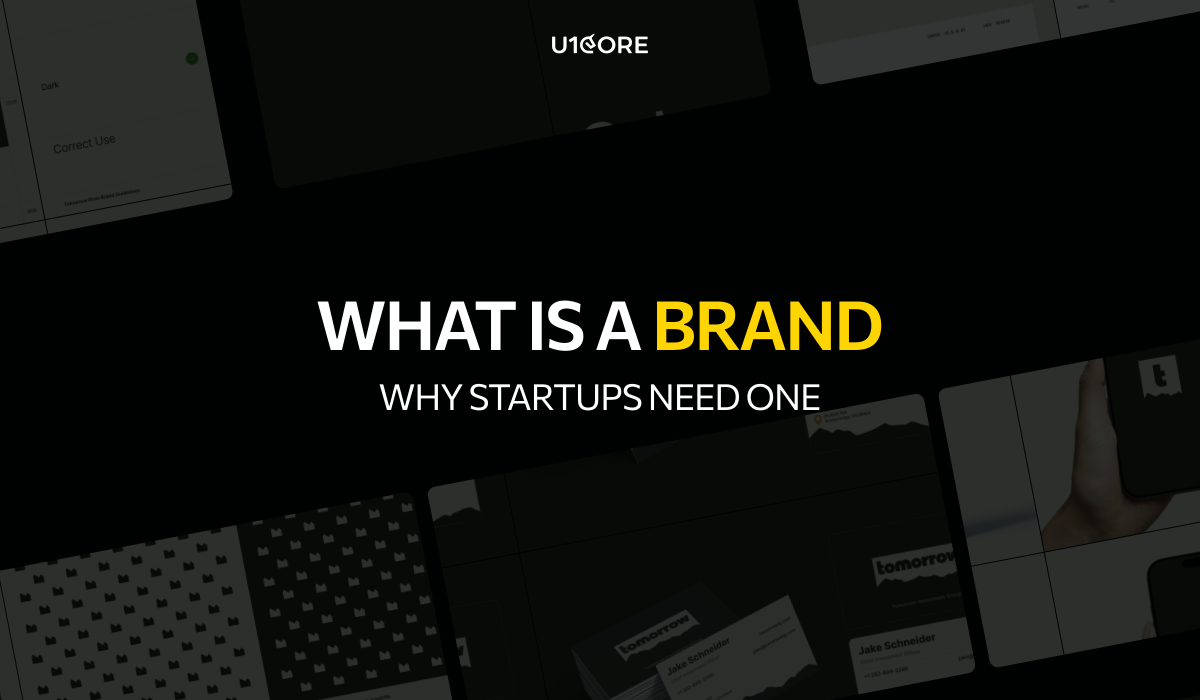
Here is how to create a brand identity from scratch — in seven steps that work at any budget.
Step 1: Define your positioning. Who are you for, what problem do you solve, why are you different?
Step 2: Define your audience specifically. “B2B SaaS companies” is not an audience. “Series A SaaS founders struggling with churn who don’t have an in-house design team” is.
Step 3: Define your brand personality. Three to five adjectives you lean into. One you explicitly avoid.
Step 4: Develop your visual identity. Logo variants, color palette with hex codes, one or two typefaces with usage rules. A one-page brand reference beats a 100-page guidelines document.
Step 5: Define your tone of voice. Three qualities you lean into, one you avoid, three on-brand examples, three off-brand examples.
Step 6: Apply consistently. A brand guide no one follows is a document, not a brand.
Step 7: Evolve deliberately. Rebrand when positioning has fundamentally shifted — not when you’re tired of the logo.
A clear startup brand strategy communicates more to investors than most founders realize — and earlier in the process.
A polished brand signals: the founders understand their customer, have the discipline to execute consistently, and understand that perception matters. This doesn’t mean you need an expensive agency before a pre-seed round. It means your materials should look like they were made by people who care about quality.
The inverse is equally true. “If they can’t execute their own brand, can they execute their product?” — a reasonable question with no good 30-minute answer.
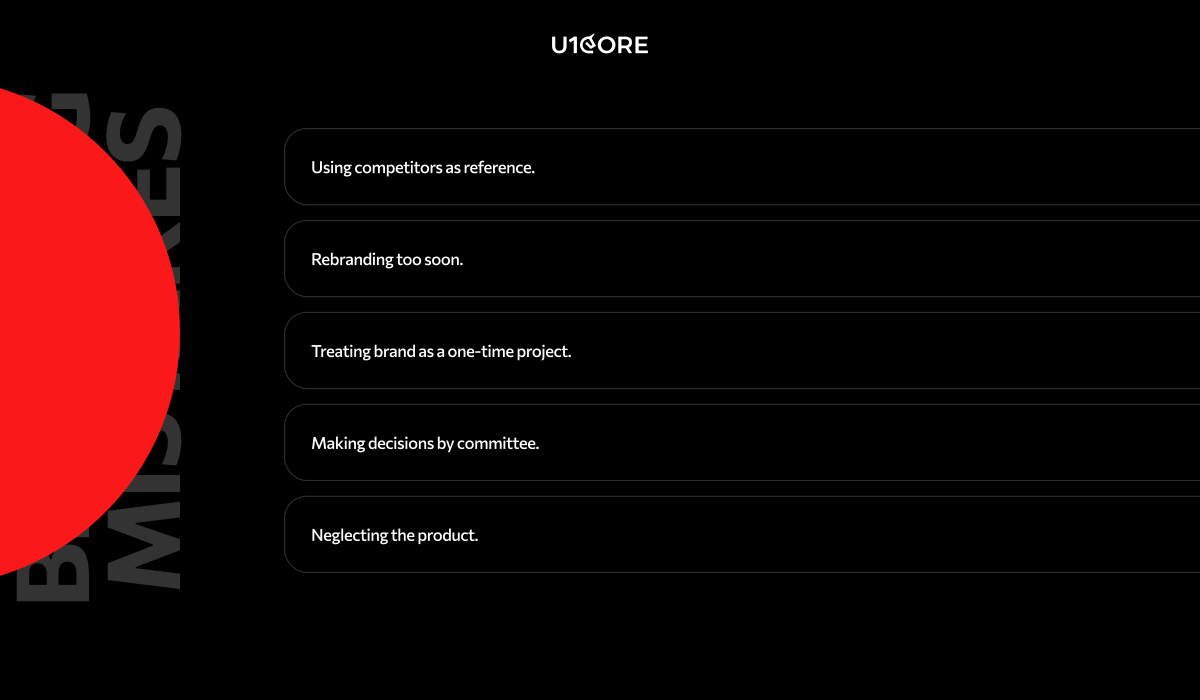
Using competitors as reference. Design against your audience and positioning — not your competitive set.
Rebranding too soon. Most startups rebrand before the brand has had time to build recognition. The instinct usually comes from founder boredom, not market signal.
Treating brand as a one-time project. Brand is an ongoing practice, not a deliverable.
Making decisions by committee. Consensus produces a brand that offends no one and stands for nothing.
Neglecting the product. For a software startup, the product interface is the highest-frequency brand touchpoint. A beautiful website and a confusing product is a gap no marketing will close.
Notion built a brand around calm productivity in a space dominated by corporate heaviness and consumer playfulness. White space, understated typography, pastel accents — a blank canvas that gets out of your way.
Linear entered a crowded category and stood out through visual identity alone. Dark mode by default. Animation as a functional signal. “Built by engineers for engineers” — before explaining a single feature. First 10,000 users before it had a marketing team.
Stripe made payments feel like a developer tool made by people who care about craft. The documentation became a brand touchpoint.
The common thread: each made a clear decision about who they were for and applied it consistently — including in the product.
DIY with templates ($0 – $500): Near zero cost. Risk: template look, no strategic framework. Right for pre-revenue startups testing a concept.
Freelance designer ($1,000 – $5,000): Logo, color palette, typography, basic guidelines. Quality varies. Right for pre-seed to seed.
Boutique design studio ($5,000 – $25,000): Strategic positioning alongside visual execution — identity, tone of voice, key touchpoints. Our branding development service at U1CORE covers this range. Right for seed to Series A.
Full-service brand agency ($25,000 – $150,000+): Research, strategy, identity, full rollout. Right for growth-stage companies repositioning or entering new markets.
The right budget matches your stage. A clear brief — positioning, audience, brand personality — outperforms a vague one with a large budget every time.
U1CORE is a product design studio specializing in branding development for startups. Book a free consultation to discuss your brand project.

During this call we do a quick intro and discuss your project and its specific needs.
During this call we do a quick intro and discuss your project and its specific needs.

Book a free consultation with us, so we will frame your product vision and strategy.

We’ve received your request and our team is already reviewing it. We’ll get back to you as soon as possible to discuss how we can help you achieve your goals.
Looking forward to collaborating with you!

We’ve sent the download link to your email. Check your inbox (and spam folder just in case) to access the eBook.
We hope you find it valuable for your Web3 journey. If you have any questions or feedback, feel free to reach out!