




- Article
How to Choose a Design Partner for a Marketplace Platform



Most articles about failed software projects blame communication, scope creep, or budget overruns. Those are symptoms. In custom platform development — marketplaces, exchanges, fleet systems, multi-sided products — the failures are structural. They’re baked into the architecture before the first sprint ends.
This guide covers the platform-specific failures that kill projects before launch, and the vetting process that prevents them. If you’re evaluating a product development agency for a platform build, these are the questions that separate studios who’ve shipped from studios who’ve Figma’d.
Every platform has two products: the one users see and the one the operations team uses. Most studios scope the first and forget the second.
A marketplace needs seller verification workflows, dispute resolution screens, content moderation queues, payout reconciliation dashboards, compliance audit trails, and permission-based access for every internal role. A fleet platform needs driver management, document expiry tracking, payout calculations, onboarding workflows, and role-specific views for ops, finance, compliance, and fleet owners.
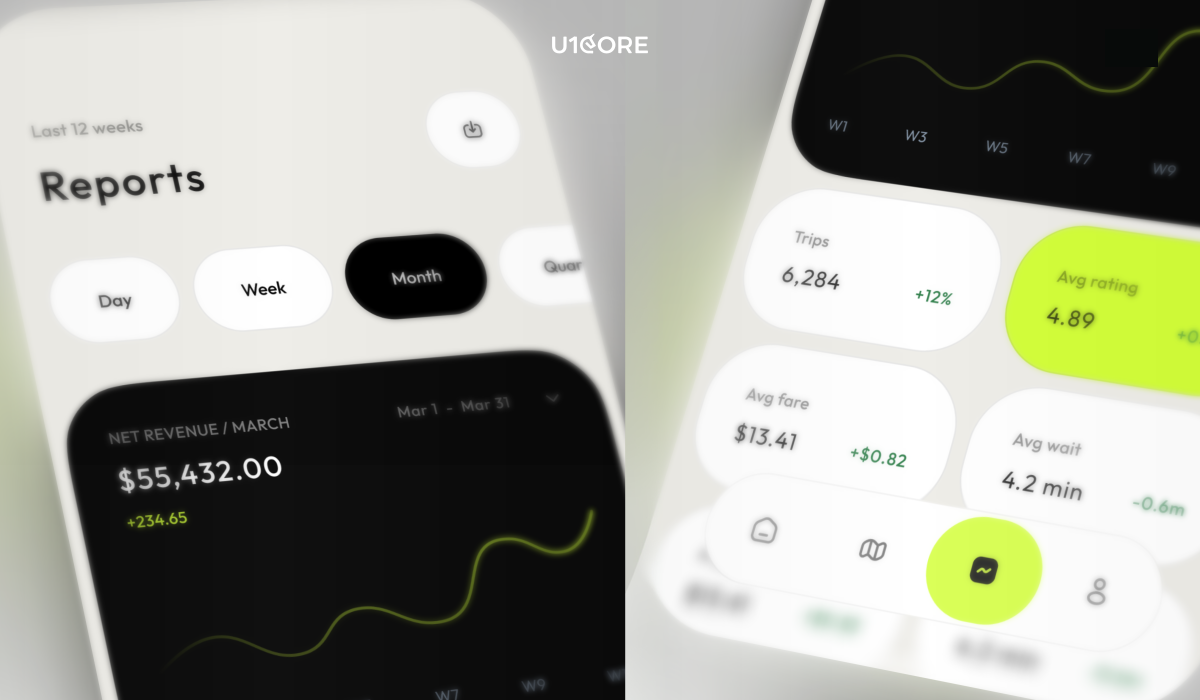
On the FluxRide fleet platform we built at U1CORE, the admin layer contains 21 modules and 13 user roles. Twenty-one modules that nobody would have budgeted for if we hadn’t scoped them in discovery. Most studios quote the driver app and the fleet owner dashboard. The admin layer — the part the operations team uses 8 hours a day — gets estimated as “admin panel” on one line of the proposal.
That one line becomes 40% of the actual build. The project goes over budget not because of scope creep but because the scope was never complete.
How to vet for this: ask the studio to list every internal role that will use the platform and what each role needs to see. If the answer is “we’ll figure out the admin panel later” — that’s where your budget overrun lives.
A custom software project that processes payments isn’t the same as one that doesn’t. Split payments, escrow, multi-currency, payout schedules, refund logic, tax withholding, and dispute holds all add architectural complexity that generic web development doesn’t prepare a team for.
The pattern we see: the studio integrates Stripe Connect in week 6 and calls payments “done.” Then the platform launches. A seller in Germany sells to a buyer in the UK. VAT calculation fails. The payout includes a refunded transaction. A dispute arrives and the platform has no designed flow to handle it.
Payment architecture for marketplace platforms needs to handle peak load — not average load. A fundraising platform that processes $720M needs to handle donation spikes during Ramadan, not just Tuesday afternoon. A fleet platform processing weekly payouts for 400 drivers needs to run 400 calculations simultaneously without errors or timeouts.
How to vet for this: ask the studio to describe their payment architecture for a platform they’ve shipped. Not Stripe integration. Architecture. Split payment logic. Escrow flow. Refund handling. Payout scheduling. Dispute resolution flow. If they can’t describe the edge cases — they haven’t built one.

A marketplace UX design that optimizes the buyer experience and treats the seller dashboard as an afterthought creates a platform that acquires buyers and churns sellers. Every design decision for one side creates friction for the other.
Lower the commission to attract sellers — your buyer protection budget shrinks. Add strict verification to protect buyers — seller onboarding slows, signups drop. Build a beautiful buyer search experience with filters — but if sellers can’t create listings with structured data that maps to those filters, search returns garbage.
Most studios design the buyer journey, then adapt the seller side. The result: a seller who lists a product and gets zero signal for 48 hours. No views. No saves. No notifications. They assume the platform is dead. They leave.
The seller’s first 48 hours need the same design attention as the buyer’s first 60 seconds. Both sides have to work from day one — not buyer first, seller “phase two.”
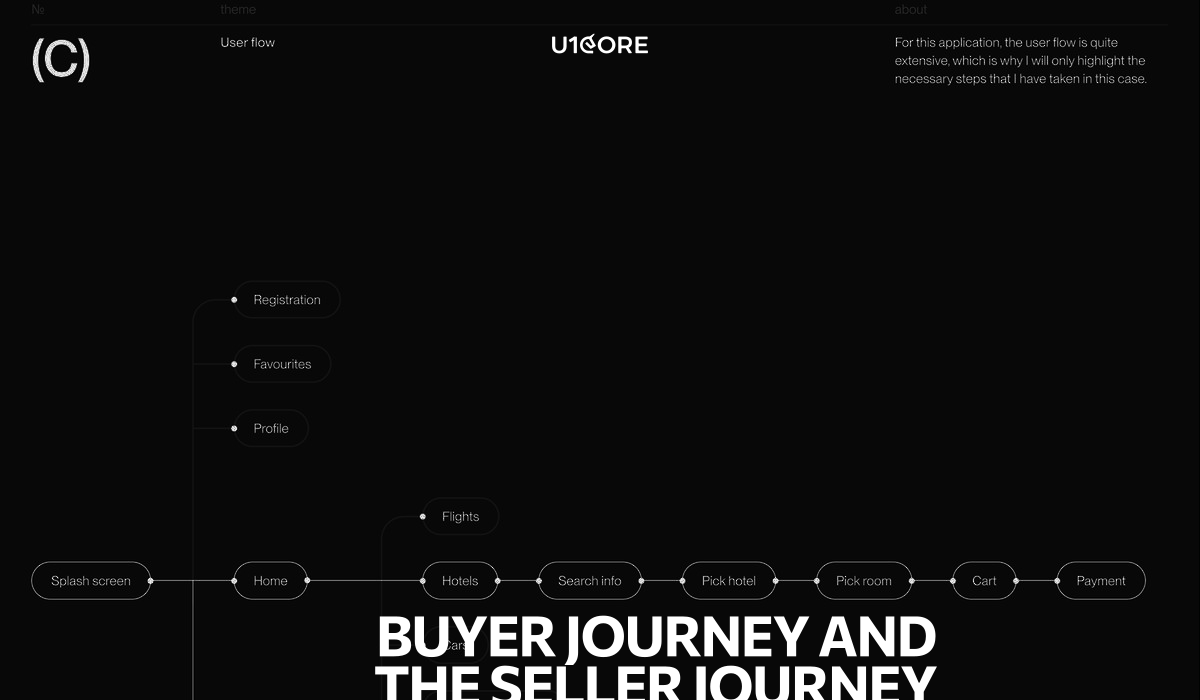
How to vet for this: ask the studio to walk you through both the buyer journey AND the seller journey for a platform they’ve built. If they can only describe one side in detail, they’ve only designed one side.
A platform with one user type needs one login. A platform with buyers, sellers, admins, moderators, finance, compliance, and support needs a role-based access model designed before the first screen is wireframed.
Adding roles after the architecture is set is not a feature request. It’s a rebuild. The database schema, API permissions, front-end routing, and notification logic all depend on the role model. Bolting on a “compliance officer view” to a system designed for two roles breaks things nobody anticipated.
The 18F guide on de-risking custom technology projects specifically flags this: teams that don’t define user roles and permissions in discovery spend 2-3x more time retrofitting access controls after launch. NIST’s Secure Software Development Framework (SSDF) identifies access control architecture as a practice that must be defined before development begins — not bolted on before compliance review.
How to vet for this: ask how many user roles the studio’s most complex platform had. If the answer is “buyer and seller” — they haven’t built a production platform. Real platforms have 5-15 roles. The studio should be able to name them.
For fintech products, banking systems, and any platform handling personal data or financial transactions, compliance isn’t a feature. It’s an architectural requirement.
KYC/AML verification flows, data privacy (GDPR/CCPA), audit trails for every transaction, consent management, document retention policies — all of these need to be designed into the system from sprint one. Retrofitting compliance into a platform that wasn’t built for it is the most expensive type of technical debt.
ISO 27001 isn’t a badge you buy — it’s a framework that describes how your system handles information security. A studio building a platform that processes payments or personal data should be able to explain how their architecture supports audit trails, access logging, data encryption at rest and in transit, and incident response procedures.
How to vet for this: ask the studio what compliance requirements your platform will need to meet, and how they’ve handled them in past builds. If they say “we’ll add that later” — the later is a rebuild.

A website is a set of pages. A platform is a system. The estimation methodology is fundamentally different.
A studio that estimates a marketplace the way they estimate a corporate website will get the number wrong by 3-5x. Platforms have state management, real-time data, concurrent users, payment flows, multi-role permissions, notification systems, and admin tooling that websites don’t.
The NIST SSDF recommends that software development estimates include security requirements, access control design, and testing scope from the initial planning phase. The 18F vendor management guide recommends that agencies require vendors to demonstrate estimation methodology — not just provide a number.
A single figure with no visible reasoning isn’t an estimate — it’s a price. And a price given before discovery is a sales tactic.
How to vet for this: ask the studio to show you their estimation breakdown for a past project. Not the total. The breakdown. Hours per module. Assumptions documented. Risk contingency. If the estimate is one number on one line — it’s a guess.
→ How many user roles did your most complex platform have? Name them.
→ Walk me through the admin layer of a platform you’ve shipped. How many modules?
→ Describe your payment architecture — not Stripe integration. Edge cases.
→ Show me both the buyer and seller journey for a platform you’ve built.
→ What compliance requirements did that platform need? How did you handle them?
→ Show me a live platform I can sign up for and use right now.
→ Show me your estimation breakdown — not the total, the methodology.
→ What happens in week one of the engagement? Discovery or wireframes?
→ Who will actually work on my project? Can I meet them before signing?
→ What does the first 48 hours look like for a seller on a platform you’ve built?
If more than three answers are vague — keep looking. The studio that checks all ten has built platforms in production. The rest have built decks in Figma.
Incomplete scoping — specifically the admin layer, payment architecture, and role-based access model. These three elements are consistently underestimated because most studios scope the user-facing product and treat operational tooling as an afterthought. The result is a 40%+ budget overrun that isn’t scope creep — it’s scope that was never captured.
Ask to see live products — not portfolios. Ask about user roles, admin modules, and payment edge cases. Ask for estimation breakdowns, not totals. A studio that has shipped platforms can describe the admin layer, the payment architecture, and both sides of the marketplace in detail. A studio that hasn’t will answer in generalities.
NIST SSDF for secure development practices, ISO 27001 for information security management, GDPR/CCPA for data privacy, and PSD2/PCI DSS for payment processing. The specific standards depend on your industry and geography, but a studio should be able to name which ones apply to your platform and explain how they’ve implemented them in past builds.
A website is a set of pages with known content. A platform is a system with state management, concurrent users, real-time data, multi-role access, payment flows, and admin tooling. Platform estimation requires decomposition by module, three-point sizing, role-based complexity scoring, and risk contingency. Website estimation requires a page count and a design complexity assessment. Using the second methodology for the first guarantees an overrun.
U1CORE is a product design and development studio specializing in marketplace platforms, fintech, fleet operations, and banking & compliance automation. $720M+ processed through platforms we’ve built. Your product team — without the equity, without the hiring. Book a strategy call.




During this call we do a quick intro and discuss your project and its specific needs.
During this call we do a quick intro and discuss your project and its specific needs.

Book a free consultation with us, so we will frame your product vision and strategy.

We’ve received your request and our team is already reviewing it. We’ll get back to you as soon as possible to discuss how we can help you achieve your goals.
Looking forward to collaborating with you!

We’ve sent the download link to your email. Check your inbox (and spam folder just in case) to access the eBook.
We hope you find it valuable for your Web3 journey. If you have any questions or feedback, feel free to reach out!
